
For more on the book of Romans, visit:
- Bible Study: Romans.
- My personal working commentary on Romans: Click Here.
A Little About Romans:
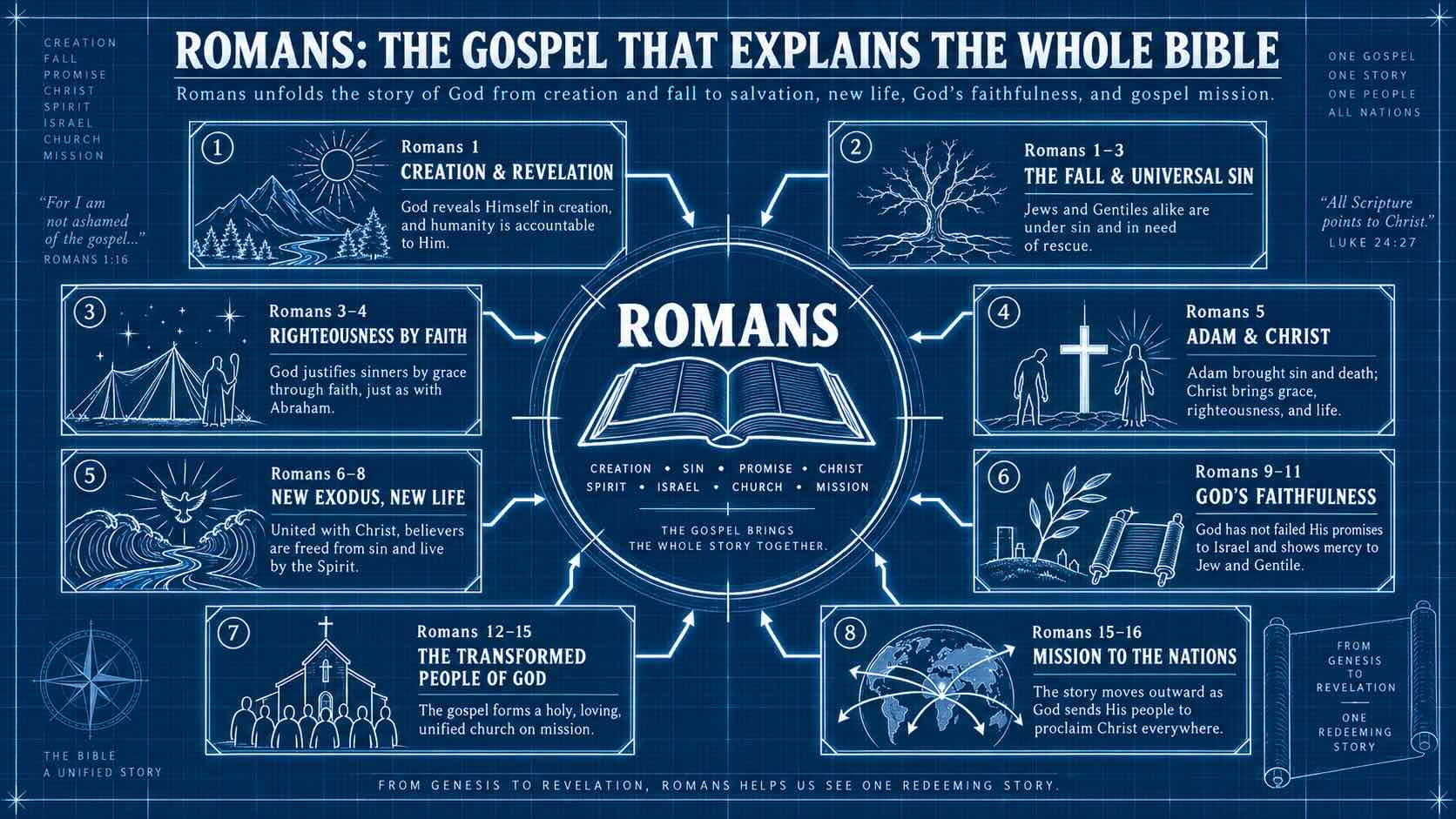
Romans has long been seen as the single greatest systematic theology of the Gospel. Many scholars believe the book of Romans can unlock the rest of the Bible when we understand why Jesus came, what His salvation does, and how we respond. Many great Christians in history, such as Augustine, Martin Luther, and John Wesley, cite Romans as the key to their salvation. Another prominent Christian named Chrysostom had the book of Romans read to him every day. A thinking person can't read Romans and come away not understanding God's great love for us. Paul writes Romans as an introduction to the people of God in Rome. He is also writing to help them realize they have a solid unifying foundation: their shared hope in the Gospel. Under Emperor Claudia, the Jewish people had been banished from Rome. Now that they are returning, there appears to be strife and division among the Jews and Gentiles. Paul spends the first part of Romans reminding the reader that we all need God's forgiveness. Then, he spends the last portion talking about how we walk in that forgiveness and freedom every day.
10 Interesting Facts about the Book of Romans > (click)
- Romans is Paul’s longest letter.
At roughly 7,100 Greek words, Romans is the longest surviving letter written by Paul and his most extensive explanation of the gospel. - Paul had never visited the Roman church when he wrote it.
Unlike churches such as Corinth or Philippi, Paul did not plant the church in Rome. He was writing to believers many of whom he had never personally met (Romans 1:10–13). - Romans was probably written from Corinth around AD 57.
Paul was nearing the end of his third missionary journey and preparing to take an offering to Jerusalem (Romans 15:25–26). - Phoebe was probably the person who delivered Romans to Rome.
Romans 16:1–2 introduces Phoebe, a respected believer from Cenchreae. Many scholars believe she carried Paul's letter to Rome—and may therefore have been the first person asked to explain parts of it to the Roman believers. - The Roman church probably met in several houses rather than one building.
Romans 16 mentions different clusters of believers, including a church meeting in the home of Priscilla and Aquila(Romans 16:5). Romans was likely read among a network of house churches throughout the city. - A major issue behind Romans was tension between Jewish and Gentile Christians.
Emperor Claudius had expelled many Jews from Rome around AD 49. After his death, Jewish believers began returning. This likely created questions about the Law, circumcision, food, holy days, Israel, and what it meant for Jews and Gentiles to become one people in Christ. - Romans contains roughly 60 direct quotations from the Old Testament.
Paul repeatedly reaches back into Genesis, Psalms, Isaiah, Deuteronomy, Hosea, and other books to show that the gospel isn't God's backup plan—it is part of the story God had been telling all along. - Paul summarizes the message of Romans very early in the book.
Romans 1:16–17 functions almost like the thesis statement:
the gospel is God's power for salvation, received by faith, revealing the righteousness of God. The rest of Romans essentially unfolds what those claims mean. - Romans ends with an unexpectedly personal chapter.
After some of the deepest theology in the New Testament, Romans 16 mentions more than two dozen people by name. Paul talks about coworkers, friends, women and men who served the church, people who suffered with him, and people he deeply loved. Romans isn't merely a theological textbook—it is theology designed to create a new kind of community. - Paul probably did not physically write most of the letter himself.
A man named Tertius served as Paul's secretary, or amanuensis. He actually identifies himself in Romans 16:22: “I, Tertius, the one writing down this letter, greet you in the Lord.”
Books I Use for Study and Reference:
- Romans: A Commentary (Martin)
- Romans (RC Sproul)
- The Epistle of the Romans (Murray)
- Romans 1-8 (NBBC)
- Romans (David Jeremiah)
- Romans 1-7 For You (Timothy Keller)
- Romans (MacArthur)
- Romans (Stott)
- Romans: Exegetical Commentary on the New Testament (Thielman)
- Romans: The Story of God (Bird)
- Romans: Christ-Centered Exposition (Merida)
- Romans/Galatians: ESV Expository Commentary
- The Wiersbe Bible Commentary of the New Testament (Wiersbe)
- Wiersbe's Expository Outlines on the New Testament (Wiersbe)
The Mission Blog Archive
Loading messages…