
Question: Hey PB! I don’t understand how to develop a biblical worldview. How do I go from reading the Bible to having it shape my life?
Answer: This is such a great question. Just like with anything else, developing a biblical worldview is both straightforward and multifaceted. Let’s talk about it.
I talk to a lot of Christians who want a biblical worldview. They want to see the world the way God sees it, make decisions that honor Him, and live out what they say they believe. Almost nobody pushes back on that goal.
Where people get stuck is the "how."
Most of us assume the answer is to read the Bible more. Maybe memorize some verses. Maybe learn what Christians are supposed to think about the big cultural issues. And honestly, all of those are good things. I'd never tell you to read your Bible less!
But a biblical worldview goes deeper than knowing what the Bible says about a list of topics. It's learning to see all of reality through what God has revealed. It shapes how you think, what you believe, how you make sense of what's happening around you, and eventually how you live on a Tuesday afternoon.
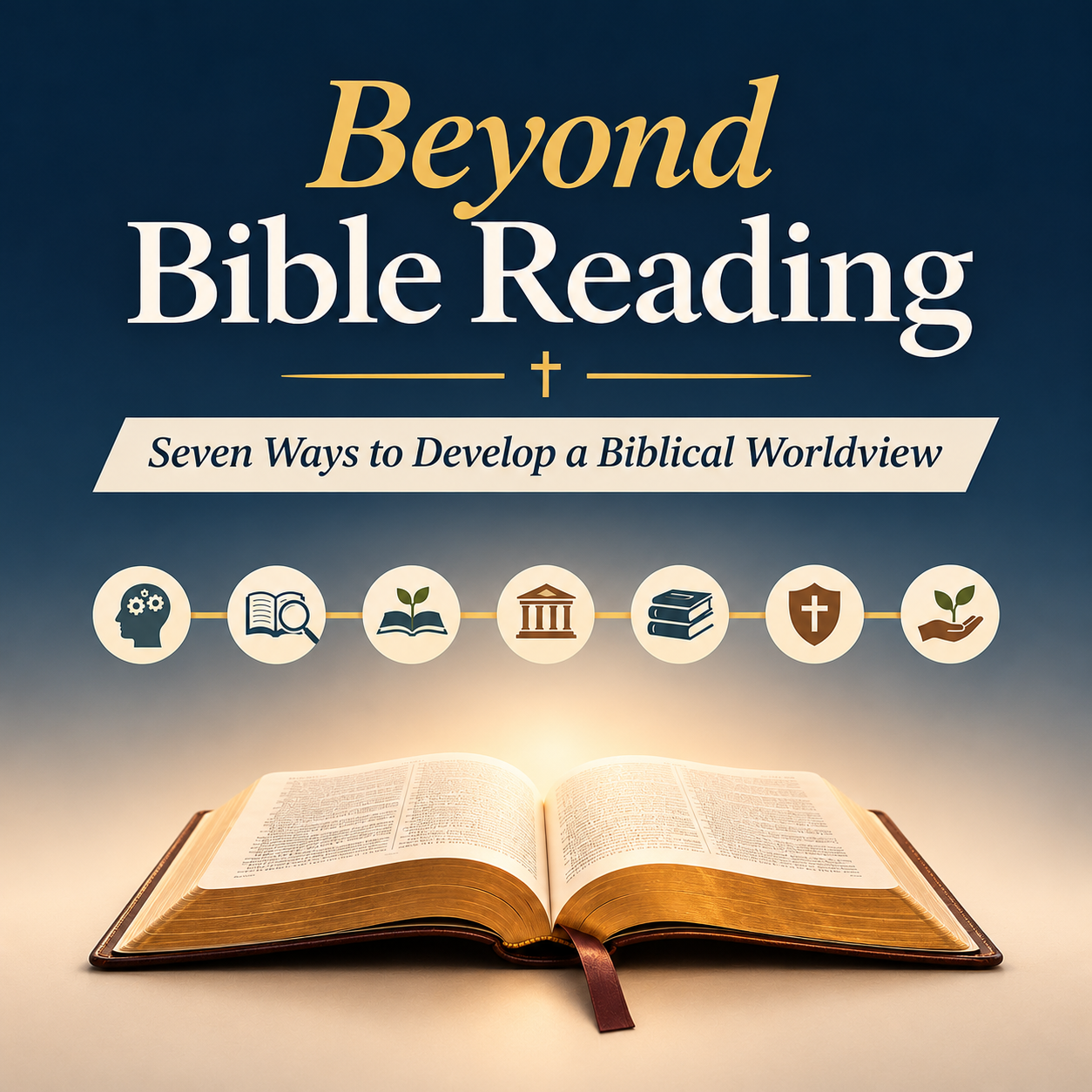
One of the most helpful ways I've found to grow here is to look at seven disciplines of Christian study. Each one builds a different muscle. And here's the good news: you don't need a seminary degree for any of them. I teach seminary students, and I can tell you that every one of these starts with ordinary believers asking good questions.
1. Logic: Thinking Clearly
Before we can figure out what's true, we have to be able to think straight.
Logic is simply the study of good reasoning. It helps you spot contradictions, notice hidden assumptions, catch bad arguments, and land on conclusions that actually follow from the evidence.
You've probably heard someone say, "Well, that might be true for you, but it's not true for me." Logic helps you see what's going on in a statement like that. There's a real difference between a personal preference (I like chocolate ice cream) and a claim about reality (Jesus rose from the dead). Those aren't the same kind of statement, and they can't be treated the same way.
Some Christians get nervous about careful thinking, like it competes with faith. It doesn't. God gave you a mind, and Jesus said loving Him includes loving Him with that mind (Matthew 22:37).
Ask yourself: Am I thinking about this clearly?
2. Biblical Exegesis: What Did It Actually Mean?
One of the easiest traps to fall into with Scripture is reading what we want a verse to mean instead of what it does mean.
Exegesis is the work of slowing down and figuring out what the human author was communicating to his original audience, in his original setting. You look at the verses around it, the historical situation, the type of literature you're reading, and who it was written to.
Jeremiah 29:11 is the classic example. It shows up on coffee mugs and graduation cards as a promise that God is going to make your plans work out. But when you read it in context, God is speaking to His people while they're in exile in Babylon, and He's telling them to settle in because they're going to be there for seventy years.
That doesn't make the verse less meaningful. If anything, it makes it more meaningful! It's a promise of God's faithfulness in the middle of a long, hard season. When we understand what it meant then, we can apply it far more faithfully now.
Ask yourself: What did this passage mean to the people who first heard it?
3. Biblical Theology: The Big Story
The Bible is 66 books, written by dozens of authors, over something like 1,500 years. And yet it tells one story: the story of God redeeming His people.
Biblical theology is about seeing how all those pieces fit together and how God's plan unfolds from Genesis to Revelation.
Take the theme of sacrifice. You can follow it from the animal skins in Genesis 3, to Abraham and Isaac on Mount Moriah, to the Passover lamb, to the whole sacrificial system in Leviticus, and finally to Jesus, the Lamb of God who takes away the sin of the world. Once you see that thread, you can't unsee it.
This is the cure for reading the Bible like a collection of inspirational quotes. Every passage belongs to a bigger story, and that story points to Jesus.
Ask yourself: Where does this passage fit in the Bible's bigger story?
4. Historical Theology: Learning from Those Who Came Before
Christianity didn't start with us. (I know that sounds obvious, but we sometimes act like it did.)
For almost 2,000 years, followers of Jesus have been reading Scripture, wrestling with hard questions, defending the faith, and trying to understand God's truth. Historical theology looks at how the church has understood, explained, debated, and clarified its beliefs over time.
For example, if you've ever wondered why Christians talk about the Trinity the way we do, with words like "one essence" and "three persons," the answer is in the early church. Those words were hammered out in serious debates over who Jesus is, and knowing that history helps you understand why the language matters.
Now, church history doesn't carry the same authority as Scripture. The Bible is always the final word. But we can learn a lot from both the wisdom and the mistakes of the believers who went before us.
Ask yourself: How have Christians understood this throughout history?
This one has a way of humbling you. It reminds you that you're part of a really big family.
5. Systematic Theology: Putting It All Together
The Bible talks about the same big subjects in lots of different places.
Systematic theology gathers up everything Scripture says about a topic and asks what the whole Bible teaches about it.
Say you want to understand salvation. You wouldn't just camp out on one verse. You'd look at grace, faith, repentance, justification, regeneration, and sanctification across the entire Bible and put the pieces together.
So the question shifts from "What does this one verse say?" to "What does the Bible as a whole teach?" Done well, that keeps your beliefs consistent and anchored in Scripture instead of built on a favorite verse or two.
Ask yourself: What does the whole Bible teach about this?
6. Apologetics: Why We Believe
This one is close to my heart, since it's a big part of what I studied and teach.
We're called to have faith. But biblical faith is not believing something for no reason. Apologetics is about giving a thoughtful explanation and defense of why Christianity is true.
It deals with questions like: Does God exist? Can we trust the Bible? Did Jesus really rise from the dead? If God is good, why is there so much suffering?
Peter tells us to always be ready to give a reason for the hope we have, and to do it with gentleness and respect (1 Peter 3:15). Don't skip that second part!
The point of apologetics is not winning arguments. I've seen people win the argument and lose the person. The real goal is to help remove the intellectual roadblocks that keep people from Jesus, to strengthen the confidence of believers, and to point everyone back to Christ.
Ask yourself: Why is this belief reasonable and trustworthy?
7. Practical Theology: Living It Out
Here's where it all lands. The goal of studying the Bible isn't to become a walking theology textbook. The goal is to become more like Jesus.
Practical theology asks how biblical truth shapes your everyday life: your relationships, your decisions, your work, your ministry, your family.
It's one thing to know what the Bible says about forgiveness. It's a whole different thing to forgive someone who really hurt you. What does that look like on Monday morning?
How does what you believe about generosity change what you do with your paycheck? How does believing that every person bears the image of God change how you treat the person who gets under your skin?
James puts it bluntly: be doers of the Word, not just hearers (James 1:22).
Ask yourself: How should I live because this is true?
Bottom Line.
Let me be clear about one thing. These seven disciplines are not seven levels of spiritual maturity, where the "really serious" Christians make it to level seven. They work together, and each one strengthens the others. I use them as buckets for learning, but they apply to our lives in different ways simultaneously.
Here's a quick way to remember them:
- Logic helps you think clearly.
- Exegesis helps you read Scripture carefully.
- Biblical theology helps you see God's big story.
- Historical theology helps you learn from the church.
- Systematic theology helps you understand what Christians believe.
- Apologetics helps you explain why it's true.
- Practical theology helps you live it out.
They overlap, and you'll keep coming back to all of them for the rest of your life. This isn't a checklist you finish in order.
And remember, a biblical worldview doesn't come together overnight, and it doesn't come from just stacking up information. It grows as you humbly study God's Word, learn to recognize truth, submit your thinking to Christ, and let the Holy Spirit change you from the inside out.
At the end of the day, the goal isn't just to know more about God. It's to know God, and to let knowing Him change everything.
Because a biblical worldview doesn't just change how you see the world. It changes how you live in it.