
Question: Hey PB, Muslims say we Christians worship three Gods? How do I better understand the Trinity?
Answer: This is a great question! Christians serve One God. God is One in Essence and Three in Person. This is a common Islamic tactic so let’s talk about it.
I still remember the first time a new believer looked at me after a Sunday service and asked, "So... is Jesus God, or the Son of God? Because those sound like two different things." I gave her the best answer I could on the spot, but I walked away thinking: I have to learn how to do better than that. So that's what this post is.
The doctrine of the Trinity is the heartbeat of Christian theology, and it's also one of the most misunderstood teachings in the church — sometimes even by the people sitting in our pews every week. If you've ever felt fuzzy trying to explain it, you're not alone, and you're in good company. Even the sharpest minds in church history have said the same thing: we can know the Trinity is true, and we can never fully wrap our minds around it. Those two things aren't in tension. They're actually the point.
What We Mean When We Say "Trinity"
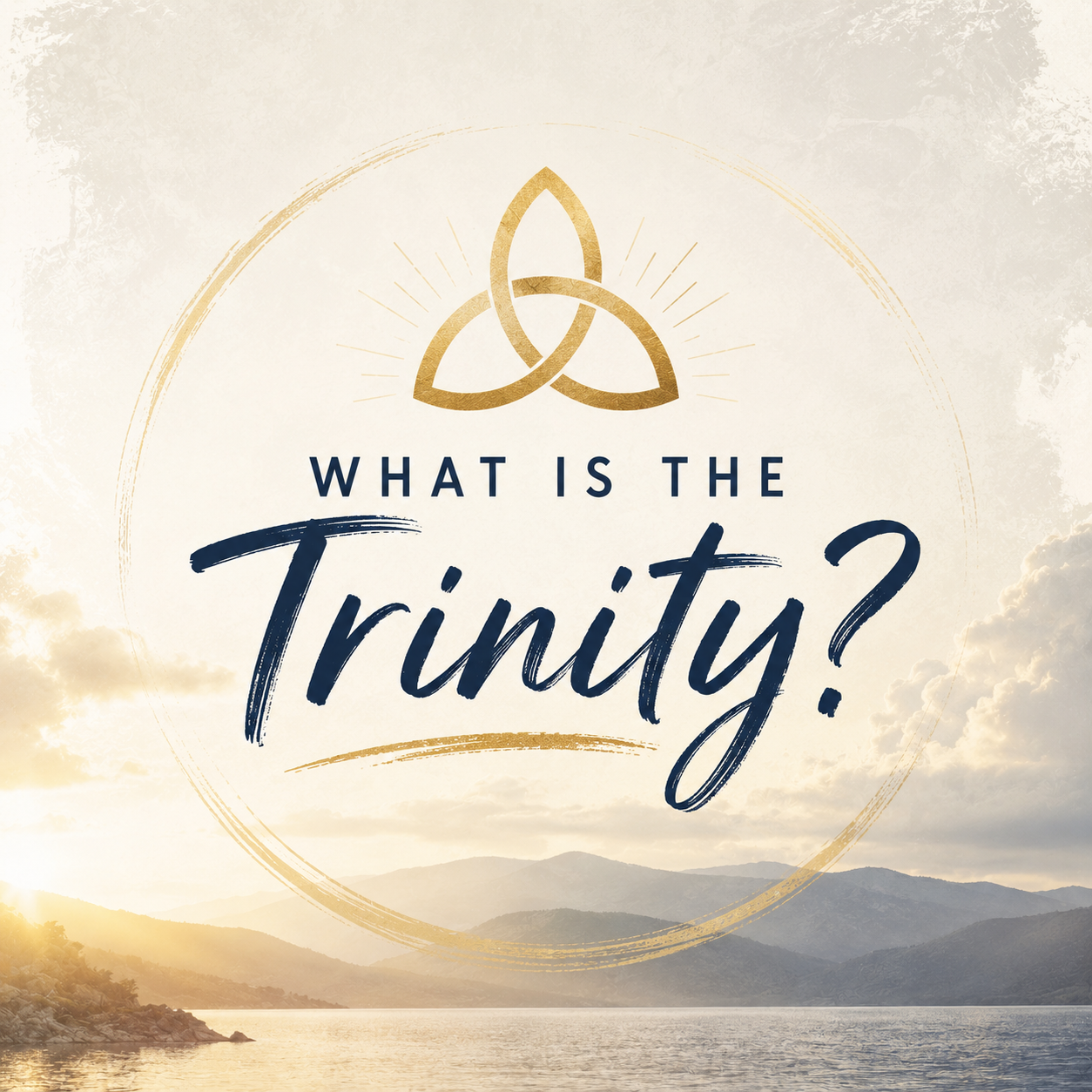
Here's the simplest definition I know, and it's worth memorizing: there is one God, eternally existing in three distinct persons — Father, Son, and Holy Spirit — each fully and equally God, yet there is only one God.
Notice what that statement is not saying. It's not saying God is one person who wears three masks depending on the situation. It's not saying there are three gods working together. It's saying something stranger and more wonderful than either of those: one what, three whos. One divine essence, three distinct persons in eternal relationship with one another.
That tension is exactly where most objections and most heresies creep in, so hang onto that definition. We'll come back to it.
Where Does This Come From in Scripture?
Here's something important to get straight from the outset: the word "Trinity" never appears in the Bible. Not once. But absence of the word is not absence of the truth — the same is true of words like "incarnation" or "monotheism," which we use constantly to summarize what Scripture teaches. The doctrine isn't built on a word search. It's built on the whole shape of biblical revelation.
It starts in Genesis. God says "Let us make man in our image" (Genesis 1:26). Hebrew scholars have debated that plural for centuries, but read alongside the rest of Scripture, it's an early whisper of something more.
It's present at Jesus' baptism. The Son stands in the water, the Spirit descends like a dove, and the Father speaks from heaven, "This is my beloved Son" (Matthew 3:16–17). Three persons, one moment, one divine work.
It's woven into the Great Commission. Jesus tells his disciples to baptize "in the name" — singular — "of the Father and of the Son and of the Holy Spirit" (Matthew 28:19). One name, three persons named within it.
It's in Paul's benediction. "The grace of the Lord Jesus Christ and the love of God and the fellowship of the Holy Spirit be with you all" (2 Corinthians 13:14). Paul isn't constructing a doctrine here — he's simply praying the way a Trinitarian already thinks.
And it's in the deity of Christ himself. John opens his Gospel by telling us the Word was with God and the Word was God (John 1:1), then tells us that Word became flesh (John 1:14). Thomas falls at the risen Jesus' feet and says, "My Lord and my God!" and Jesus doesn't correct him (John 20:28). Paul tells the Colossians that in Christ "the whole fullness of deity dwells bodily" (Colossians 2:9).
The pattern isn't a handful of proof texts stitched together. It's the consistent shape of how God reveals himself across both testaments — one God, three persons, each fully divine, none of them the other.
Where the Word "Trinity" Came From
If the word isn't in Scripture, where did we get it? The credit usually goes to Tertullian, a North African theologian writing around AD 200, who coined the Latin term trinitas to describe what the church already believed and had been confessing since the apostles. He wasn't inventing a new doctrine — he was giving a name to something the church had been living out and defending against heresy for over a century.
The doctrine got sharpened, not invented, in the centuries after. At the Council of Nicaea in AD 325, the church responded to a man named Arius, who taught that Jesus was a created being, not eternally God. The council affirmed that the Son is "of the same substance" (homoousios) as the Father — fully God, not a lesser or created deity. At the Council of Constantinople in AD 381, the church further clarified the full deity of the Holy Spirit against those who wanted to reduce him to a mere force or influence.
So here's the important distinction: the word Trinity and the precise language used to defend it developed over time, in response to real controversies. But the substance of the doctrine — one God, three persons — is there from Genesis through Revelation. The councils didn't create the Trinity. They protected it from being distorted.
Answering the Common Objections
"The Trinity is just borrowed from pagan mythology."
This claim gets repeated a lot online, but it doesn't hold up under scrutiny. Pagan "trinities" — like the Egyptian or Babylonian triads people point to — are usually three separate gods loosely grouped together, not one being in three co-equal, co-eternal persons. That's a fundamentally different concept. The biblical doctrine emerged from Jewish monotheism wrestling honestly with the fact that Scripture calls the Father God, the Son God, and the Spirit God, while insisting there is only one God (Deuteronomy 6:4). That's not paganism. That's exegesis under pressure.
"It's a math contradiction — 1+1+1 can't equal 1."
It would be a contradiction if we were saying God is three in the same sense he is one. We're not. God is one in essence (what he is) and three in person (who he is). That's not 1+1+1=1. It's more like saying a single object can have three distinct real dimensions without becoming three objects. The analogy isn't perfect — no human analogy for the Trinity ever is — but the logic isn't broken. It's just describing a being unlike anything else in creation, which is exactly what we should expect God to be.
"Jesus never said 'I am God.'"
He didn't need to use those exact words to make the claim unmistakable. He forgave sins directly (Mark 2:5–7), something the religious leaders rightly recognized only God could do. He accepted worship without rebuke (Matthew 14:33). He said, "Before Abraham was, I am" (John 8:58), deliberately invoking God's covenant name from Exodus 3:14 — and the crowd picked up stones, because they understood exactly what he meant.
"This was invented at Nicaea for political reasons."
This is popular thanks to novels and documentaries, but it's not what the historical record shows. The Council of Nicaea didn't vote a new doctrine into existence — it examined what the church had already been teaching and worshiping for three centuries and rejected Arius's departure from it. Writings from before Nicaea — Ignatius, Justin Martyr, Irenaeus — already show Christians worshiping Jesus as God and referring to Father, Son, and Spirit together. Nicaea clarified the language. It didn't invent the belief.
Bottom Line.
I've met believers who treat the Trinity like a theological trivia question, something you affirm to pass a doctrinal quiz and then set aside. But this doctrine isn't abstract speculation. It's the ground beneath everything else we believe.
If the Trinity isn't true, the cross isn't what we think it is — it's not God himself bearing the weight of sin, just a good man dying a tragic death. If the Trinity isn't true, the Spirit's presence in you isn't God dwelling with his people, just some lesser force. And if the Trinity isn't true, then eternal, self-giving love wasn't happening before creation ever existed — because love requires more than one person, and before creation, God had no one to love but himself, in himself, as Father, Son, and Spirit. The Trinity is the reason we can say, without hesitation, that God is love (1 John 4:8) — not that he merely learned to love once something existed to love. He has always been a communion of persons in perfect love. That's the God we were made to reflect.
Next Steps.
If this doctrine has felt more like a puzzle than a foundation, here's how I'd encourage you to move forward:
- Look for the Trinity in God’s Word. Sit with the baptism of Jesus in Matthew 3, John 1, and John 17 slowly, in prayer, and let the relationship between Father, Son, and Spirit shape how you pray, not just what you believe.
- Incorporate the Trinity into your prayer time. You have access to the Father, through the Son, by the Spirit. That's not theological decoration — it's the actual architecture of Christian prayer.
- Talk about the Trinity in your LifeGroup. You don't need seminary Greek. You need the definition above, three or four of these passages, and honesty about the mystery.
- Hold the mystery without embarrassment. You don't have to fully explain God to faithfully worship him. Some things about God were always meant to be adored more than they're explained.
The Trinity isn't a riddle the church invented to make Christianity harder. It's the truest, deepest thing we know about who God is — and the more you sit with it, the more it stops feeling like a doctrine to defend and starts feeling like the God you were made to know.