
Welcome to Part 7 of 10 our Frequently Asked Questions series. These are the top ten questions I receive As a pastor.
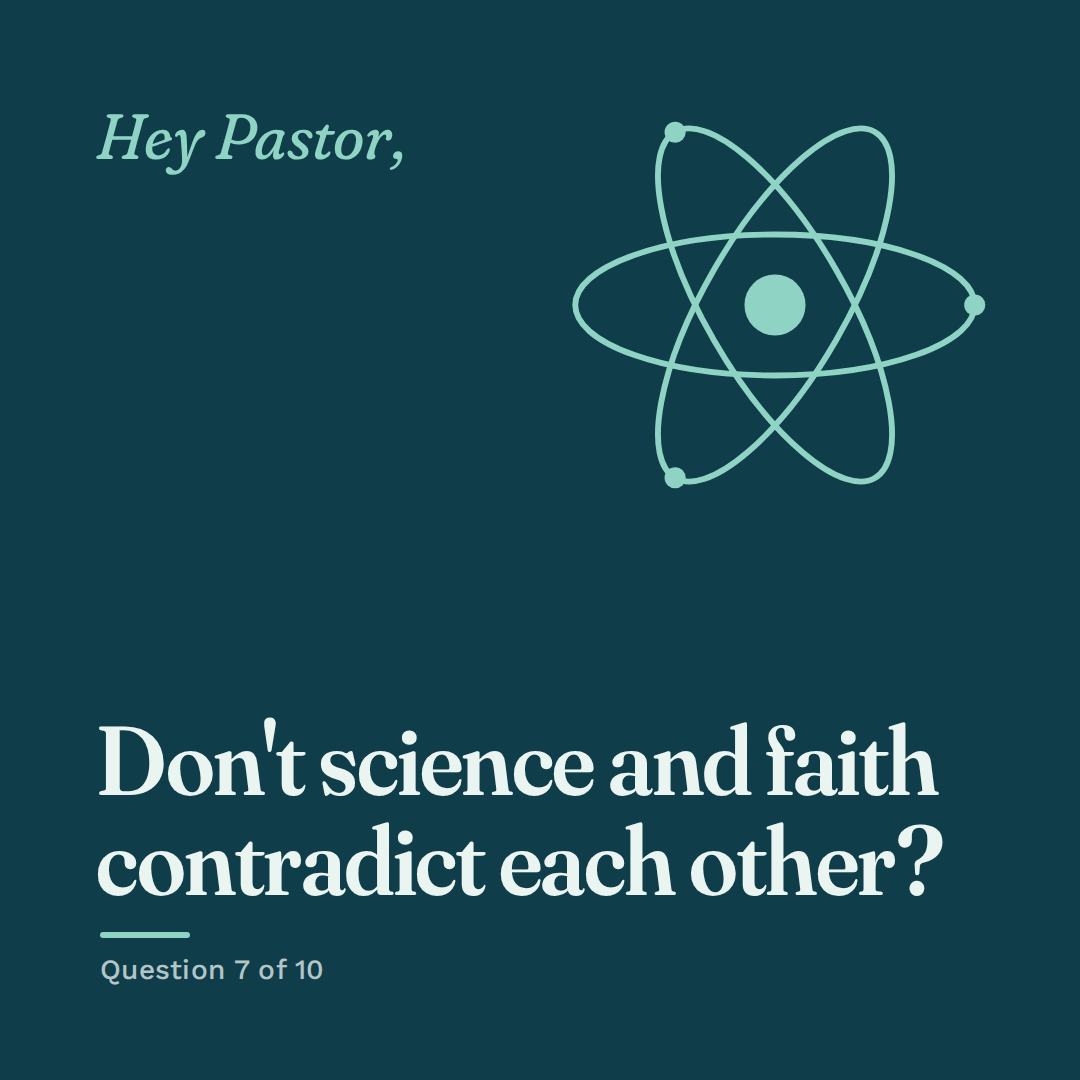
Question: Hey Pastor, my science teacher says believing in God is unscientific. Do I have to choose between science and faith?
Answer: Great question! Let's get into it.
The short answer is no, you don't have to choose. But I understand why it feels that way. Our culture often tells a story where science and religion are locked in a war, and science keeps winning. It's a dramatic story. It just isn't true.
Science grew up in a Christian neighborhood
Here's something a lot of people don't know. Modern science was largely born in a Christian world, and many of its founders were committed believers. Johannes Kepler, who figured out how the planets move, is often quoted as saying his work was "thinking God's thoughts after Him." Isaac Newton wrote more about theology than he did about physics. Robert Boyle, Michael Faraday, and James Clerk Maxwell were all people of deep faith.
The list keeps going. Gregor Mendel, the father of genetics, was a monk. Georges Lemaître, the scientist who first proposed what we now call the Big Bang theory, was a Catholic priest. In our own day, Francis Collins, who led the Human Genome Project, is an outspoken follower of Jesus.
Why did science flourish among Christians? C.S. Lewis explained it beautifully in his book Miracles:
"Men became scientific because they expected Law in Nature, and they expected Law in Nature because they believed in a Legislator."
Think about that. Science only works if the universe is orderly, predictable, and understandable. Why would we expect that? Christians believed a rational God created a rational world and made us in His image so we could understand it. Science didn't push God out. Faith in God helped make science possible.
They answer different questions
Science is an incredible tool. It's great at answering "how" questions. How do stars form? How does a virus spread? How does the heart pump blood?
But there are questions science can't answer, because they aren't the kind of questions a test tube can measure. Why is there anything at all? What is the meaning of my life? What is right and wrong? Why is the universe understandable in the first place?
Here's a simple picture. Imagine a kettle boiling on the stove. Someone asks, "Why is the water boiling?" A scientist says, "Because heat energy is exciting the water molecules." I say, "Because I want a cup of tea." Both answers are true. They're just answering different questions. Science explains the mechanism. Faith speaks to the purpose behind it.
Genesis 1 tells us who created and why. It was never meant to be a science textbook. Faithful Christians hold different views on how to read the details of the creation account, and that's okay. But all of us agree on the main point: "In the beginning God created the heavens and the earth."
The more we discover, the more we wonder
Scripture actually invites scientific discovery. "Great are the works of the LORD; they are pondered by all who delight in them" (Psalm 111:2). Proverbs 25:2 says, "It is the glory of God to conceal a matter; to search out a matter is the glory of kings."
Every time a scientist uncovers how something works, they're uncovering the handiwork of God. And the more we learn, the more amazing it gets. The universe had a beginning. Its physical laws are finely tuned for life. DNA carries information like a language. These discoveries don't make God less likely. They make Him more obvious.
Paul says of Jesus, "For in him all things were created: things in heaven and on earth... He is before all things, and in him all things hold together" (Colossians 1:16-17). The same Jesus who saves us is the One holding the atoms together.
Your mind is a gift too
Here's one more thing to think about. If there's no God, your brain is just the product of random processes that were aimed at survival, not truth. So why should we trust it to do science at all? Lewis made this point often: if our thoughts are only the accidental byproduct of atoms, we have no reason to believe our thoughts are true.
Christianity gives us a reason to trust our reasoning. We were made by a Mind, for the purpose of knowing Him and His world.
So study hard. Ask questions. Love science. Jesus told us to love God with all our mind (Matthew 22:37). You don't have to turn off your brain to follow Jesus. Following Jesus is the best reason to turn it on.