
Question: What is Hanukkah, and should I celebrate it? Did Jesus?
Answer: Great question. Yes, Jesus would have celebrated Hanukkah. In John 10, it says Jesus celebrated the "Feast of Dedication." That is Hanukkah! You do not have to celebrate this holiday, but knowing about it can enrich your thankfulness this time of year. Let's talk about it.
Every year, around the time we celebrate Christmas, our Jewish neighbors and friends celebrate a holiday called Hanukkah. You’ve probably seen the menorahs in store windows, heard about spinning dreidels, or noticed shelves of chocolate coins wrapped in gold foil. When I was a kid, I celebrated Hanukkah. (No, I am not Jewish. My family was just really excited about the Jewish holidays.)
Hanukkah is more than holiday decor or tradition. It’s an amazing story of courage, faith, and perseverance. Believe it or not, Christians have something deeply meaningful to learn from it.
A Story of Opposition and Hope
Hanukkah goes back over 2,100 years to a time when God’s people lived under the rule of the Seleucid Empire, long after the Old Testament era. A ruler named Antiochus IV Epiphanes came to power and tried to force Jewish people to abandon their faith, stop practicing the Law, and worship the Greek gods instead.
He even desecrated the Temple in Jerusalem—God’s holy place—by sacrificing pigs and setting up idols. For devout Jews, this wasn’t just offensive. It was unbearable.
But God stirred bravery in a faithful family known as the Maccabees. Led first by a priest named Mattathias, and later by his son Judah Maccabee, a small group stood against a massive empire. Against all odds, they reclaimed the Temple, cleansed it, and rededicated it to the Lord.
That word—rededication—is where we get the name Hanukkah.
The Miracle of the Oil
According to Jewish tradition, when the Maccabees prepared to relight the Temple’s seven-branched lampstand (the menorah), they found only enough consecrated oil for one day.
But God did something remarkable.
The oil burned for eight days. This was long enough to prepare more oil in accordance with God’s requirements. That lasting light became a symbol of God’s provision when His people had nothing left except faith.
Hanukkah Today: How It’s Celebrated
Modern Hanukkah celebrations remember the miracle and the victory.
Families and communities:
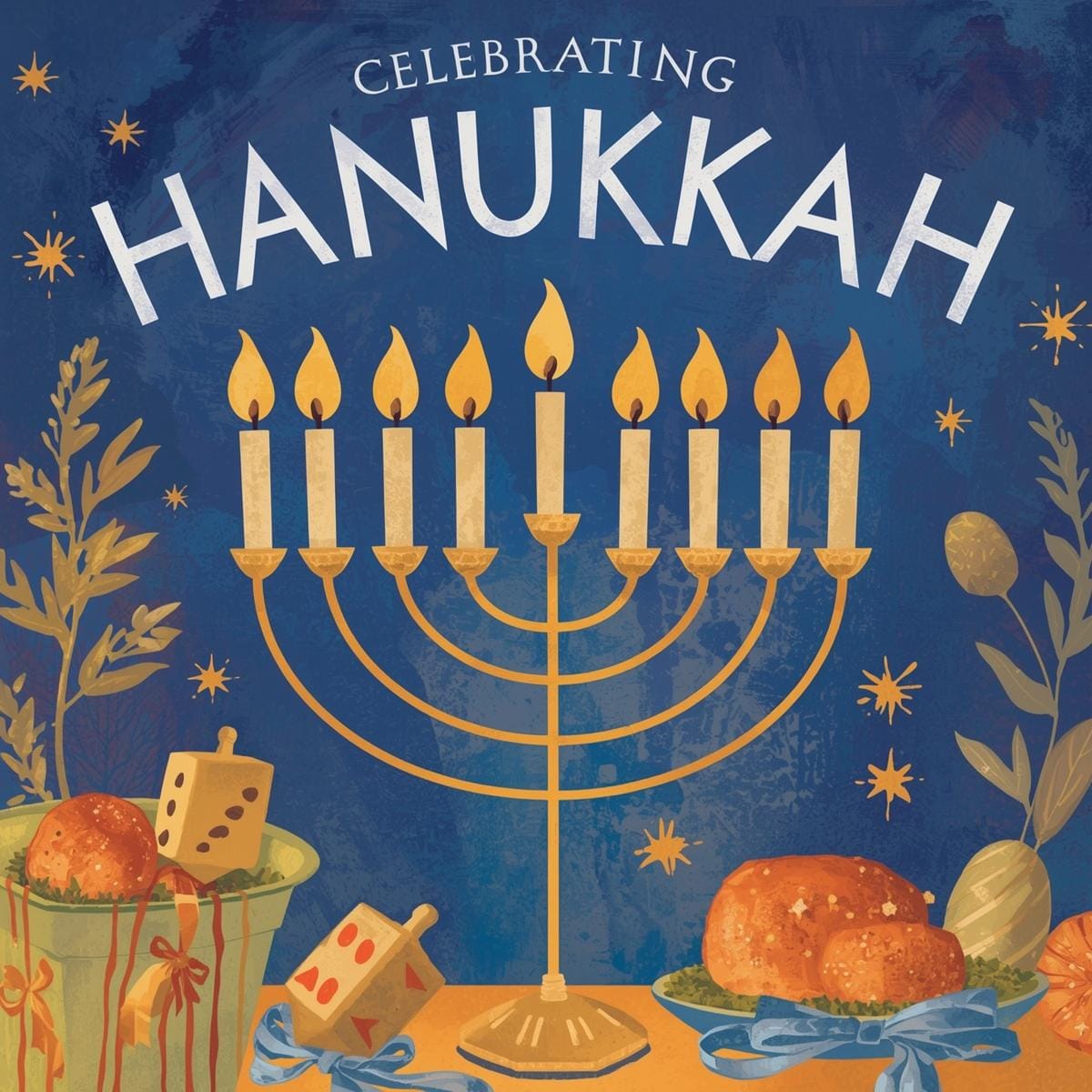
- Light a hanukkiah, a menorah with eight candles and one helper candle.
- Play dreidel, a spinning top that recalls a time when Jewish children secretly studied Scripture.
- Share foods cooked in oil, like latkes (potato pancakes) and sufganiyot (jelly doughnuts)—a delicious reminder of the oil miracle.
- Exchange gifts.
All of these celebrations remind us that we live in a world of blessings and miracles.
Where Christianity and Hanukkah Meet
Some Christians are surprised to learn that Jesus celebrated Hanukkah.
John 10:22-23 says:
“It was now winter, and Jesus was in Jerusalem at the time of the Festival of Dedication.”
The Festival of Dedication is Hanukkah.
Jesus walked the same Temple courts where the Maccabees once fought to preserve faithfulness to God. And while Hanukkah celebrates physical freedom and restored worship, Jesus came to offer something deeper:
- Jesus became the true and final Temple.
- Jesus came to pour out the oil of the Holy Spirit.
- Jesus defeated all His enemies and conquered sin, death, and darkness.
Hanukkah shines a spotlight on a truth fulfilled in Christ:
Light belongs to God, and darkness cannot extinguish it.
(John 1:5)
What About Today
As followers of Christ, Hanukkah reminds us:
- God is faithful to preserve His people even when the cultural pressures compromise.
- Every generation must choose to rededicate itself to God.
- Light may appear small, but when God is involved, it is unstoppable.
So while Hanukkah is not a Christian holiday, it is a meaningful part of our shared heritage of faith.
It invites us to remember:
- When circumstances look impossible... God is still working.
- When darkness presses close... God’s light is stronger.
- When faithfulness feels costly... obedience is worth it.
Bottom Line
As Christmas approaches, we celebrate the birth of Jesus. He is the Light of the World.
Just as the menorah burned longer than expected, may our faith burn brighter than the world believes it can.
And just as the Temple was rededicated, may we rededicate our lives, our worship, and our hope to the One who keeps His promises.
“You are the light of the world. A city on a hill cannot be hidden.” — Matthew 5:14