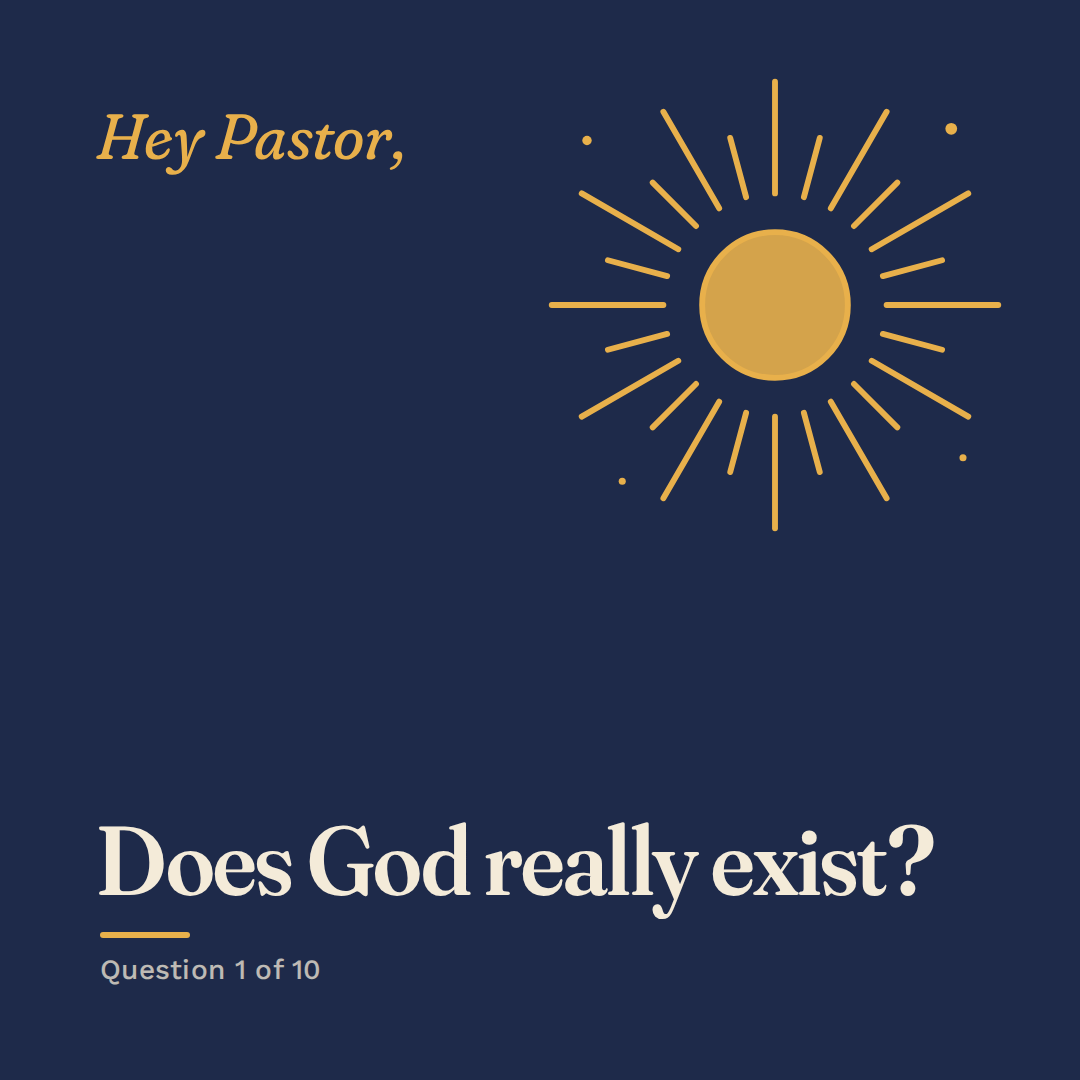

Welcome to Part 1 of 10 our Frequently Asked Questions series. These are the top ten questions I receive As a pastor.
Question: Hey Pastor, how can I actually know God exists? Sometimes it feels like I'm just supposed to believe it.
Answer: Great question! Let's get into it.
I want to start with something that might surprise you: asking this question does not make you a bad Christian. Some of the strongest believers I know got there by wrestling with this exact question. Biblical faith is never blind. It is trust based on evidence. God doesn't ask you to check your brain at the church door.
So let's look at three clues that point us toward God. None of them is a magic formula, but together they make a compelling case.
Clue #1: Something rather than nothing
Look around. The universe exists. Here's the thing: everything we know of that begins to exist has a cause. And the scientific evidence tells us the universe had a beginning. Time, space, matter, and energy all came into being at a definite point in the past. So what caused it?
Whatever caused the universe can't be part of the universe. It has to be outside of time, outside of space, immaterial, and unimaginably powerful. Sound familiar? The very first verse of the Bible says, "In the beginning God created the heavens and the earth" (Genesis 1:1). Long before modern cosmology, Scripture told us the universe had a starting point and a Starter.
Clue #2: Design
The universe isn't just here. It's finely tuned for life. If gravity, the forces inside the atom, or the expansion rate of the universe were off by even a tiny fraction, there would be no stars, no planets, and no you. Then zoom in on a single cell and you find DNA, an information code more complex than any software ever written.
Paul says in Romans 1:20, "For since the creation of the world God's invisible qualities, his eternal power and divine nature, have been clearly seen, being understood from what has been made, so that people are without excuse." David put it more poetically: "The heavens declare the glory of God; the skies proclaim the work of his hands" (Psalm 19:1). When you see a painting, you know there's a painter. Creation carries a signature.
Clue #3: The moral law inside you
This is the clue that got C.S. Lewis. Lewis was a committed atheist and an Oxford professor. One of his big reasons for rejecting God was all the cruelty and injustice in the world. But then he noticed a problem with his own argument. He wrote in Mere Christianity:
"My argument against God was that the universe seemed so cruel and unjust. But how had I got this idea of just and unjust? A man does not call a line crooked unless he has some idea of a straight line."
Think about that. Every one of us knows some things are really wrong. Not just unpopular. Not just inconvenient. Wrong. Abusing a child is wrong. Racism is wrong. Betraying a friend is wrong. Where does that sense come from? If we are just the product of time plus chance, morality is nothing more than opinion. But nobody actually lives that way. We live like there's a real standard, a straight line we measure everything against.
Paul says God's law is written on our hearts, with our "consciences also bearing witness" (Romans 2:15). That moral compass inside you is a fingerprint of the One who made you.
But here's the best part
Arguments can point you toward God, but they can't introduce you to Him. That's where Jesus comes in. Christianity doesn't just say "some kind of God exists." It says God stepped into history. John 1:18 tells us, "No one has ever seen God, but the one and only Son, who is himself God and is in closest relationship with the Father, has made him known."
If you want to know what God is like, look at Jesus. Watch how He touches lepers, welcomes outsiders, forgives His enemies, and walks out of a tomb. God isn't hiding. He showed up.
So what do I do with this?
Let me give you a few next steps. First, be honest with God about your questions. He can handle them. Read the Psalms sometime and you'll see that God's people have always brought Him their hard questions.
Second, keep looking. Hebrews 11:6 says God "rewards those who earnestly seek him." And Jeremiah 29:13 promises, "You will seek me and find me when you seek me with all your heart."
Third, read one of the Gospels this week. Mark is short and fast-paced. Read it with one question in mind: "Who is this man?"
Here's what I've found after years of walking with people through this. The question usually isn't whether there's enough evidence for God. There's plenty. The real question is whether we're willing to follow where the evidence leads. I pray you will. And if you have more questions, keep them coming. That's what we're here for.