
Question: Pastor, some of my favorite preachers are online I listen to them every week. (Pastor tries not to take that too personally, but this person doesn’t attend church every week. ha) Is there a way to know if they are any good or not?
Answer: So I am not sure by what you mean by good. I assume, because you enjoy listening to them, you’re not asking if they are engaging. You are likely asking if they teach sound doctrine. This is an amazing question and shows you’re growing in your faith. Let’s talk about it.
Every so often, someone will ask me a version of this question:
“Are there certain pastors or preachers I shouldn’t listen to?”
Usually, they follow it with a few names.
It is an understandable question. There are more sermons, podcasts, YouTube channels, books, and Christian voices available to us than at any other point in history. That can be a tremendous gift.
It can also make discernment more difficult. My first instinct, however, is not to give someone a list of approved and unapproved preachers.
Why? Because eventually they are going to encounter someone who isn’t on my list.
What they really need is not a blacklist, but a filter so they can learn how to discover the truth of God’s Word for themselves.
The goal of Christian maturity isn’t simply knowing which teachers your pastor approves of. The goal is learning how to listen carefully, think biblically, and recognize whether what you’re hearing is faithful to Scripture.
The Difference Between a False Teaching and a False Teacher.
This concept is helpful and the reason why we do this. Not all false teachings come from false prophets, but all false prophets promote some type of false teaching. Hopefully this will be helpful.
False Teaching- A false teaching is anything that is contrary to the orthodox, historical teaching of the Bible. This type of teaching tries to add or takeaway from what is stated in God’s Word. An example of this would be any doctrine against the Trinity such as Oneness theology. The catch with this is that the person who teaches this may be a sincere Christian, but has started teaching an error. They are not purposefully trying to lead someone away from God. Therefore, a good teacher can possibly teach false teaching. This is why we need a filter.
False Teacher- A false teacher is someone who teaches false doctrines and knows it is leading someone away from the simple truth of God’s Word. They use false teaching to spread their false doctrine on purpose. These people are dangerous. They must be recognized and avoided.
The only way to tell is through praying (getting God involved,) creating a filter, and trusting the Holy Spirit.
The Bereans provide a great example.
(Acts 17:11) “They received the word with eagerness and examined the Scriptures daily to see if these things were so.”
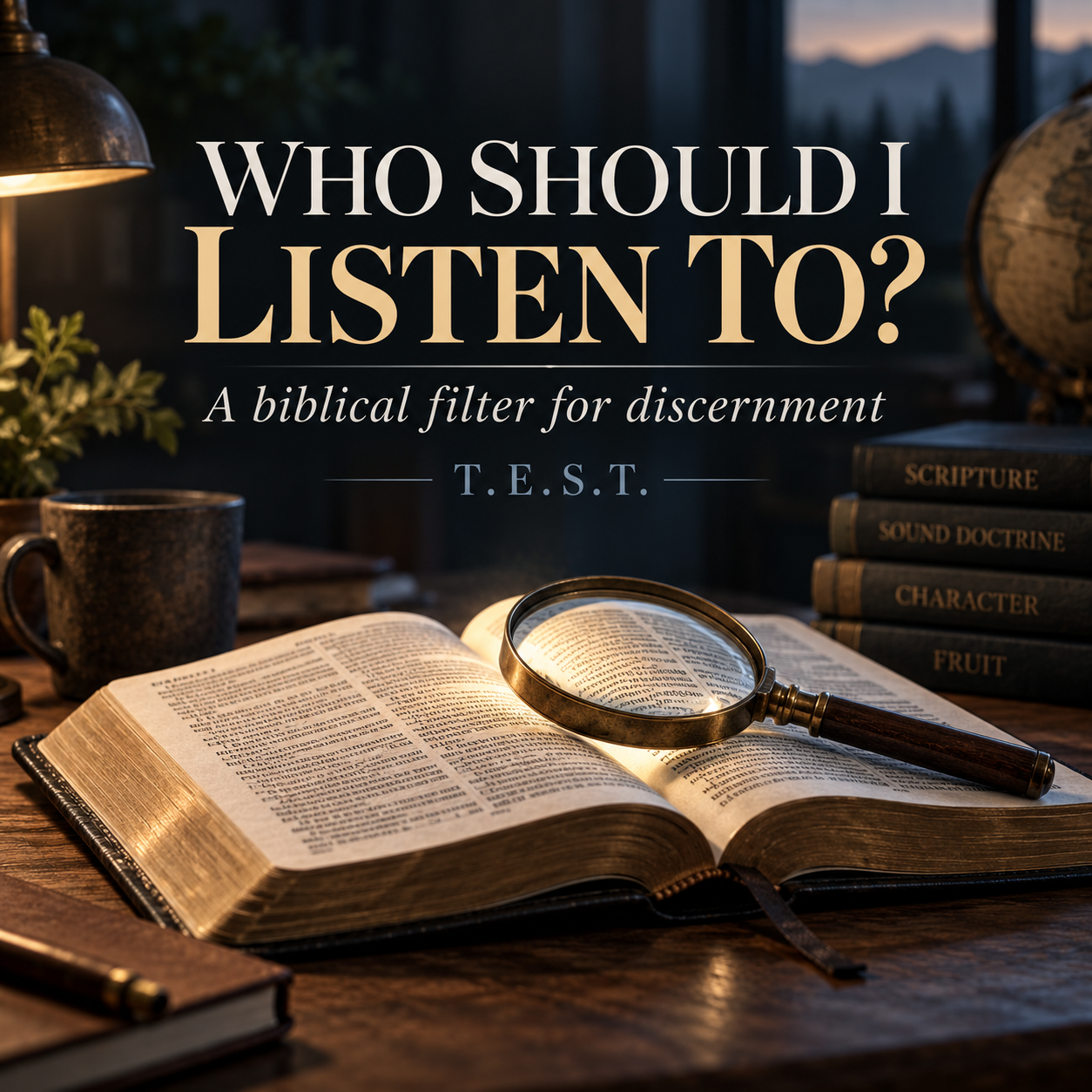
Notice what they did... They listened and they also checked. That’s a healthy posture for every Christian. So when you’re listening to a preacher, podcast, teacher, author, or Christian influencer, I would encourage you to put what you’re hearing through the T.E.S.T.
T- Does It Faithfully Handle the TEXT?
The first question is the most important: Is this actually what the Bible says?
A preacher can be charismatic, funny, inspiring, intelligent, and incredibly gifted at communication while still handling Scripture poorly. Pay attention to how the Bible is being used.
Is the preacher explaining what the passage means in its context? Or are they taking one sentence out of a chapter and using it to say something the biblical author never intended? There is nothing wrong with a sermon being practical. Scripture is incredibly practical. But biblical preaching should begin with what God has said rather than beginning with what we want to say and searching for a verse that seems to support it.
This is why you should never turn your brain off just because someone is standing behind a pulpit. Keep your Bible open and read the verses before and after the passage.
Ask: “Is that really what this text is saying?”
You don’t have to be a seminary professor to practice biblical discernment. You simply have to become a careful student of Scripture.
Dr. Norman Geisler said, “The Bible, we believe. Everything else, we consider.”
E- Does It Affirm the ESSENTIALS?
Christians can disagree about a lot of things. We can disagree about worship styles, church government, spiritual gifts, end-times timelines, Calvinism and Arminianism, methods of ministry, and dozens of other theological questions. Some disagreements matter more than others, but not every disagreement is a gospel issue. When evaluating a teacher, ask whether they faithfully teach the essentials of historic Christianity.
- What do they believe about Jesus?
- Do they proclaim His death and resurrection?
- Do they teach salvation by God’s grace through faith?
- Do they take sin and repentance seriously?
- Do they affirm the authority of Scripture?
- Do they preach the gospel Christians have confessed for generations?
There is a significant difference between: “I disagree with this pastor about something.” and “This pastor is teaching something that undermines the gospel.”
We shouldn’t make secondary doctrines more important than they are, but we also shouldn’t make essential doctrines less important than they are. Mature discernment learns the difference.
Regrettably it can be difficult to know this by only listening to one or two sermons. You have to listen to a few and may even need to set a meeting with the pastor. (If this is possible.) Most pastors will not mind a meeting like this.
S- Does It Point Me to the SAVIOR?
This is one of my favorite questions… After listening to this person, who seems bigger: Jesus or the preacher?
Healthy Christian teaching ultimately directs our attention toward Christ. That doesn’t mean every sermon has to sound exactly the same or that every message must end with the exact same gospel presentation, but there should be a gravitational pull toward Jesus.
Christianity is not primarily a program for becoming a more successful version of yourself.
The message of Christianity isn’t:
- Believe in yourself.
- Unlock your potential.
- Dream bigger.
- Become unstoppable.
Some of those ideas may contain elements of practical wisdom, but they aren’t the gospel. That’s called Moral Therapeutic Deism. It is a dangerous theology because it makes us and our mental health at the center of the Gospel. We are not at the center, Jesus is.
Christian preaching should continually remind us that Jesus is the hero of the story.
- He saves.
- He transforms.
- He forgives.
- He restores.
- He deserves the glory.
Be cautious whenever Christianity slowly becomes centered on the preacher’s personality, platform, success, revelation, brand, or lifestyle. Good pastors don’t create disciples of themselves. They point people toward Jesus.
T- Is It Producing TRANSFORMATION?
Jesus taught that fruit matters. So another important question is: What kind of person does this teaching encourage me to become?
Healthy biblical teaching should gradually produce a life that looks more like Jesus. It should encourage us to:
- Love God more deeply.
- Obey Him more faithfully.
- Repent more quickly.
- Love people more sacrificially.
- Serve rather than simply consume.
- Become involved in the life of the local church.
- Grow in humility.
- Pursue holiness.
- Become increasingly like Christ.
That transformation doesn’t happen overnight, but there should be movement. If someone’s teaching consistently feeds pride, anger, greed, fear, obsession with success, contempt for other Christians, or fascination with the teacher themselves, something is wrong.
Biblical truth doesn’t merely inform us… overtime, it transforms us.
Some Red Flags to Watch For
- There isn’t a perfect preacher.
- Every pastor will occasionally say something poorly, interpret a passage differently than you do, or preach a sermon that isn’t their best.
- One bad sermon doesn’t necessarily make someone a false teacher.
- Patterns matter.
I become much more concerned when I see repeated patterns such as:
- Consistently twisting Scripture to make it say something it doesn’t say.
- Manipulating people financially or treating giving as a formula for becoming wealthy.
- Building Christianity around the pastor’s personality rather than Jesus.
- Regularly minimizing sin, repentance, holiness, or obedience.
- Denying essential Christian beliefs.
- Demonstrating serious character problems without accountability or repentance.
There is an important difference between imperfection and deception. Every pastor is imperfect. That includes me.
But when someone consistently moves away from Scripture, away from the gospel, and toward themselves, we should pay attention.
What About a Pastor I Don’t Agree With?
This may be the most important part.
You don’t have to agree with someone about everything to learn something from them.
And you don’t necessarily have to reject everything someone has ever said because you disagree with them about something. Discernment requires more maturity than that. There are pastors I appreciate who hold theological positions I don’t share. There are authors who have helped me tremendously even though I wouldn’t recommend everything they have written. There are communicators who have taught me something valuable even though I wouldn’t build my theology entirely around their ministry.
The question isn’t:
“Does this person agree with me about everything?”
The better question is:
“Can I listen to this person while continuing to test what they say against Scripture?”
That’s Christian discernment. Don’t Outsource Your Discernment
One danger of asking, “Which pastors am I allowed to listen to?” is that we can unintentionally outsource our responsibility to discern truth.
Bottom Line.
Scripture calls every believer to grow.
- Learn your Bible.
- Learn theology.
- Ask questions.
- Listen carefully.
- Think critically.
- Talk with mature Christians.
- Stay connected to a healthy local church.
- Practice discernment.
That means you shouldn’t listen uncritically to your favorite celebrity pastor. You also shouldn’t listen uncritically to your own pastor…including me.
If something I teach doesn’t seem consistent with Scripture, open your Bible and examine it.
Online Preaching Should Supplement Your Church, Not Replace It
Let’s also get to the bottom line… Your favorite online preacher may be incredibly helpful, BUT…
- they aren’t your pastor
- They don’t know your name
- They don’t know your family
- They aren’t going to visit you at the hospital
- They aren’t walking alongside you through suffering
- They aren’t helping you navigate your marriage, raise your children, serve your community, or grow alongside other believers.
Christianity was never designed to be lived through an algorithm. Online sermons, podcasts, books, and ministries can be wonderful supplements, but they shouldn’t replace belonging to a healthy local church where you can be known, challenged, encouraged, discipled, and sent into mission.