
Welcome to the first part of our series, "Merficul One."
Here is today's text:
(Jonah 1:1-17) The Lord gave this message to Jonah son of Amittai: 2 “Get up and go to the great city of Nineveh. Announce my judgment against it because I have seen how wicked its people are.”
3 But Jonah got up and went in the opposite direction to get away from the Lord. He went down to the port of Joppa, where he found a ship leaving for Tarshish. He bought a ticket and went on board, hoping to escape from the Lord by sailing to Tarshish.
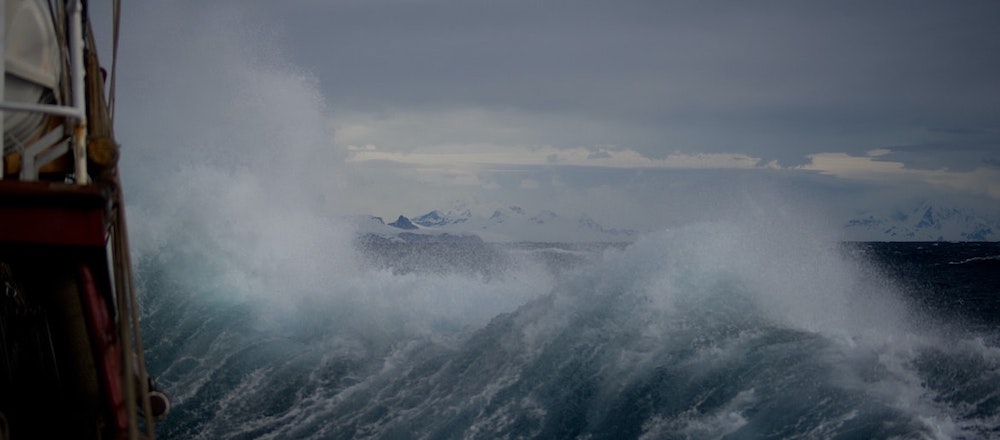
4 But the Lord hurled a powerful wind over the sea, causing a violent storm that threatened to break the ship apart. 5 Fearing for their lives, the desperate sailors shouted to their gods for help and threw the cargo overboard to lighten the ship.
But all this time Jonah was sound asleep down in the hold. 6 So the captain went down after him. “How can you sleep at a time like this?” he shouted. “Get up and pray to your god! Maybe he will pay attention to us and spare our lives.”
7 Then the crew cast lots to see which of them had offended the gods and caused the terrible storm. When they did this, the lots identified Jonah as the culprit. 8 “Why has this awful storm come down on us?” they demanded. “Who are you? What is your line of work? What country are you from? What is your nationality?”
9 Jonah answered, “I am a Hebrew, and I worship the Lord, the God of heaven, who made the sea and the land.” 10 The sailors were terrified when they heard this, for he had already told them he was running away from the Lord. “Oh, why did you do it?” they groaned. 11 And since the storm was getting worse all the time, they asked him, “What should we do to you to stop this storm?”
12 “Throw me into the sea,” Jonah said, “and it will become calm again. I know that this terrible storm is all my fault.” 13 Instead, the sailors rowed even harder to get the ship to the land. But the stormy sea was too violent for them, and they couldn’t make it. 14 Then they cried out to the Lord, Jonah’s God. “O Lord,” they pleaded, “don’t make us die for this man’s sin. And don’t hold us responsible for his death. O Lord, you have sent this storm upon him for your own good reasons.” 15 Then the sailors picked Jonah up and threw him into the raging sea, and the storm stopped at once! 16 The sailors were awestruck by the Lord’s great power, and they offered him a sacrifice and vowed to serve him. 17 Now the Lord had arranged for a great fish to swallow Jonah. And Jonah was inside the fish for three days and three nights.
 Brandon Cannon
Overall Commentary: 🌎
📖 Background of the Book of Jonah
- Author: Traditionally attributed to Jonah himself (cf. 2 Kings 14:25), though the book is written in the third person.
- Date: Likely written in the 8th century BC (during the reign of Jeroboam II, around 780–750 BC).
- Setting: The story moves between Israel and Nineveh, the capital of Assyria (a powerful and brutal enemy of Israel).
- Historical Context: Assyria was known for violence and oppression. Nineveh represented everything Israel feared and hated.
🧭 Basic Structure of Jonah
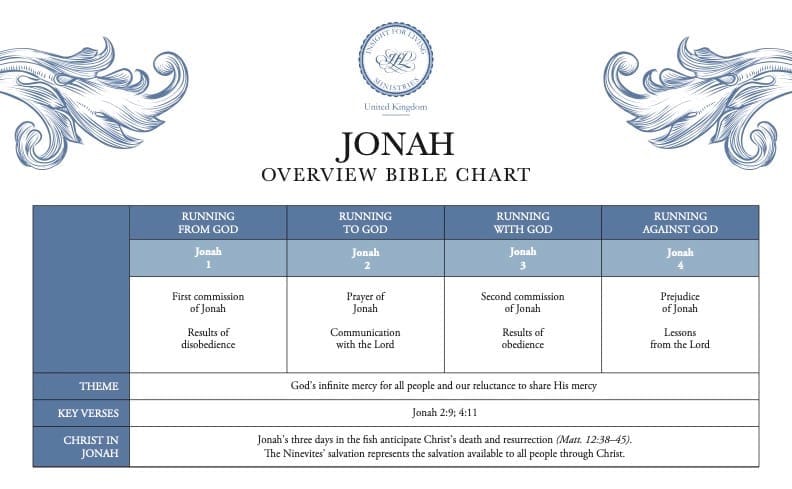
- Chapter 1 – Running from God
Jonah flees from God’s call and ends up in a storm at sea. - Chapter 2 – Crying out to God
Jonah prays from inside the great fish after being thrown overboard. - Chapter 3 – Obeying God (as a bitter bird)
Jonah goes to Nineveh and preaches; the people repent. - Chapter 4 – Resenting God
Jonah becomes angry at God’s mercy toward Nineveh.
🔑 Key Themes
- God’s Mercy is for Everyone
Not just Israel—God cares about even Israel’s enemies. - You Can Run, But You Can’t Escape God
God pursues Jonah even in rebellion. - Repentance Matters
Nineveh responds quickly, while Jonah resists. - God’s Compassion vs. Human Hardness
Jonah struggles with the very mercy God freely gives.
🧠 Why Jonah is Unique
- It’s more about the prophet than the prophecy.
- The “villains” (Ninevites) repent, while the “hero” (Jonah) struggles.
- It ends with a question from God, inviting the reader to respond.
⚡Bottom Line of the Book
God shows relentless mercy... even when we run, resist, or resent it.
The book of Jonah is fascinating. It is read every year on the Day of Atonement as a reminder of our need for mercy and that God will provide it. The book of Jonah is also thought by many to be the most humorous book of the Old Testament. It is intended to be read with moments of satire in mind. We are supposed to be amazed by Jonah's stubbornness and the situations he finds himself in, while God remains patient and merciful.
Today's Commentary.
Verse 1-3: The Self-Centered Prophet.
Verse 1.
- The original Hebrew begins with the word for "and." This is intended to seem as though we are picking up in the middle of a story. Since the book of Jonah is often praised for its beautiful construction, its wording is not accidental. The goal is for this to be a fast-paced story.
- Jonah is also talked about in 2 Kings. He was, apparently, a central figure in the kingdom at the time. He was probably trained by Elisha and prophesied prosperity over the kingdom.
Verse 2.
- The Hebrew way of saying "Get up" denotes doing so right away.
- "Great city" seems to indicate its prominence, but Nineveh was also massive. Some think it might have been the largest city in the world at the time.
- Wicked- The people of Assyria were extremely wicked. They were known for their brutality, including making their conquered army carry the heads of their families on poles as a form of shame.
Verse 3.
- Port of Joppa- This was only about 50 miles away from Jerusalem and a major port town.
- Tarshish- While it is not certain exactly where this is, Tarshish was on the other side of the sea. It was literally the furthest point on the map for the people of Israel at the time. This is the Bible saying he was going in as far as he could in the opposite direction.
- "Escape the presence of the Lord"- This means Jonah was planning to quit being a prophet. This was him resigning and leaving the temple. He is likely not thinking he can escape God but escape the responsibility of God's decree.
Verse 4-16: The Storm.
Verse 4-5.
- "powerful wind"- storms in the Mediterranean Sea could have winds up to 90 mph. These are hurricane-force winds.
- "fearing for their lives"- For the sailors to become afraid, it must have been a bigger storm than they were used to seeing. This made them begin to think there was something supernatural occurring.
- "threw over cargo"- This shows how desperate they were. The cargo was how they made a profit on these voyages. To throw over the cargo was to lose the profits.
- "Asleep"- Many scholars have differing opinions on what to make of this. The main thing is to see the book of Jonah engaging in satire again. While the paganistic sailors are fearing for their lives, the "man of God" is asleep.
Verse 6.
- They realized something supernatural was happening and were polytheistic. In their culture, any number of gods could be upset and cast judgment on them. Therefore, their way of fixing the problem was to pray until they found the right one. This is another way of showing the absurdity of what is happening.
Verse 7-8.
- Casting lots was a common way of figuring out what God might be saying. The hope was that God would cause the dice to fall the way He saw fit.
Verse 9-11.
- "I am a Hebrew"- Hebrews were the main way the Jewish people were known by Gentiles.
- "I worship the LORD."- LORD = Yahweh. The way Jonah describes the Lord, He is letting them know the God He serves is the One True God above all other things worshipped.
- When the sailors heard that He was running from Yahweh, they were terrified. Undoubtedly, they had heard of the power of Yahweh.
Verse 12.
- "Throw me into the sea"- Jonah does not know there is a fish waiting for him. It appears as though Jonah is willing to die to save everyone else. At this point, he realizes God is not letting him go.
Verse 13-14.
- Though pagan sailors, they did not immediately agree to throw Jonah overboard, which would certainly have resulted in his death.
Verse 15-16.
- Seeing God do this miracle caused them to worship God.
Verse 17. An Unexpected Miracle.
Verse 17.
- What was the "great fish?" The Bible does not give us a definitive idea. It could have been a large fish, such as a whale. There are at least three types of whales that have been recorded in modern history to have swallowed people, who were later recovered alive. These three are the sperm whale, the blue whale, and the Whale Shark.
- In 1930, a Blue Whale was found with a mouth that was 10ft wide. Whales can also have air sacs in their nasal cavities. These compartments can be up to 7ft high and wide.
- In 1891, a man named James Bartley spent 36 hours inside a whale. When the whale was captured and cut open, he was alive but unconscious. His skin was bleached from exposure to stomach acids.
God's Promise:
(Lamentations 3:21-24) Yet I still dare to hope when I remember this: The faithful love of the Lord never ends! His mercies never cease. Great is his faithfulness; his mercies begin afresh each morning. I say to myself, “The Lord is my inheritance; therefore, I will hope in him!”
Resources
To find further sources I am using to study this book, look at the bottom of the overview page in my public commentary.
David Guzik
https://www.thegospelcoalition.org/commentary/jonah/
Dr. Michael A. Milton
 Olive Tree Staff