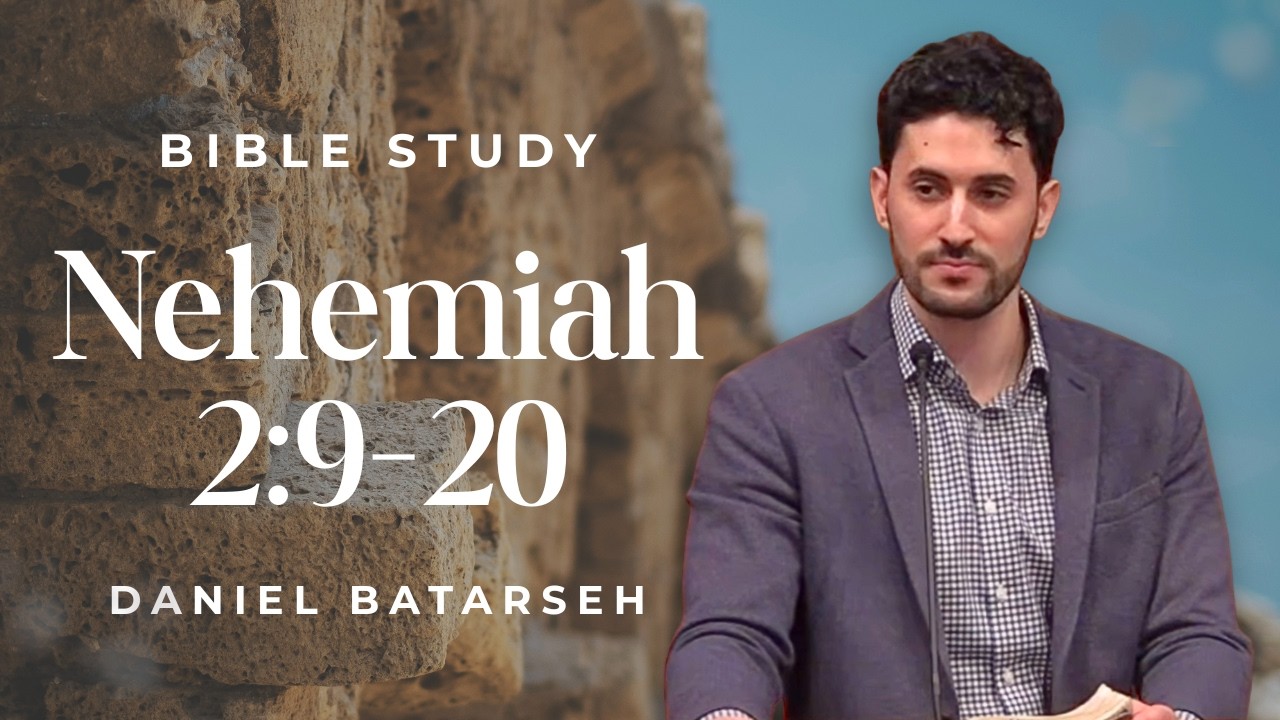


This is the Second part of our series entitled: Built Different.
(Nehemiah 02) Early the following spring, in the month of Nisan, during the twentieth year of King Artaxerxes’ reign, I was serving the king his wine. I had never before appeared sad in his presence. 2 So the king asked me, “Why are you looking so sad? You don’t look sick to me. You must be deeply troubled.” Then I was terrified, 3 but I replied, “Long live the king! How can I not be sad? For the city where my ancestors are buried is in ruins, and the gates have been destroyed by fire.” 4 The king asked, “Well, how can I help you?”
With a prayer to the God of heaven, 5 I replied, “If it please the king, and if you are pleased with me, your servant, send me to Judah to rebuild the city where my ancestors are buried.” 6 The king, with the queen sitting beside him, asked, “How long will you be gone? When will you return?” After I told him how long I would be gone, the king agreed to my request.
7 I also said to the king, “If it please the king, let me have letters addressed to the governors of the province west of the Euphrates River, instructing them to let me travel safely through their territories on my way to Judah. 8 And please give me a letter addressed to Asaph, the manager of the king’s forest, instructing him to give me timber. I will need it to make beams for the gates of the Temple fortress, for the city walls, and for a house for myself.” And the king granted these requests, because the gracious hand of God was on me.
9 When I came to the governors of the province west of the Euphrates River, I delivered the king’s letters to them. The king, I should add, had sent along army officers and horsemen to protect me. 10 But when Sanballat the Horonite and Tobiah the Ammonite official heard of my arrival, they were very displeased that someone had come to help the people of Israel.
11 So I arrived in Jerusalem. Three days later, 12 I slipped out during the night, taking only a few others with me. I had not told anyone about the plans God had put in my heart for Jerusalem. We took no pack animals with us except the donkey I was riding. 13 After dark I went out through the Valley Gate, past the Jackal’s Well, and over to the Dung Gate to inspect the broken walls and burned gates. 14 Then I went to the Fountain Gate and to the King’s Pool, but my donkey couldn’t get through the rubble. 15 So, though it was still dark, I went up the Kidron Valley instead, inspecting the wall before I turned back and entered again at the Valley Gate.
16 The city officials did not know I had been out there or what I was doing, for I had not yet said anything to anyone about my plans. I had not yet spoken to the Jewish leaders—the priests, the nobles, the officials, or anyone else in the administration. 17 But now I said to them, “You know very well what trouble we are in. Jerusalem lies in ruins, and its gates have been destroyed by fire. Let us rebuild the wall of Jerusalem and end this disgrace!” 18 Then I told them about how the gracious hand of God had been on me, and about my conversation with the king.
They replied at once, “Yes, let’s rebuild the wall!” So they began the good work. 19 But when Sanballat, Tobiah, and Geshem the Arab heard of our plan, they scoffed contemptuously. “What are you doing? Are you rebelling against the king?” they asked. 20 I replied, “The God of heaven will help us succeed. We, his servants, will start rebuilding this wall. But you have no share, legal right, or historic claim in Jerusalem.”
10 Interesting Facts About the Book of Nehemiah
- Nehemiah wasn’t a priest—he was a government official.
He served as the cupbearer to King Artaxerxes of Persia (Nehemiah 1:11). That was a highly trusted political position, giving him access and influence. - Nehemiah rebuilt Jerusalem’s walls in only 52 days.
Despite opposition, threats, and internal problems, the wall was completed incredibly quickly (Nehemiah 6:15). - The walls had been broken down for roughly 140 years.
Jerusalem was destroyed by Babylon in 586 BC, while Nehemiah arrived around 445 BC. What had remained broken for generations was rebuilt in less than two months. - Nehemiah prayed before he acted.
One of the major themes of the book is the combination of prayer and practical action. Nehemiah repeatedly prays—and then immediately gets to work. See Nehemiah 1:4–11; 2:4–5; 4:9. - Nehemiah prayed some remarkably short prayers.
When the king suddenly asked him what he wanted, Nehemiah says, “Then I prayed to the God of heaven, and I answered the king…” (Nehemiah 2:4–5). It was apparently a quick, silent prayer in the middle of a conversation. - The builders worked with a tool in one hand and a weapon nearby.
Because their enemies threatened to attack, the people built the wall while remaining prepared to defend themselves (Nehemiah 4:16–18). It creates one of the book’s most memorable images: building and battling at the same time. - Nehemiah faced opposition from outside and problems from inside.
Sanballat, Tobiah, and Geshem opposed the rebuilding externally, but Nehemiah also had to confront injustice, exploitation, and selfishness among his own people in Nehemiah 5. - Nehemiah refused to be distracted by fake emergencies.
His enemies repeatedly invited him to meet with them, probably intending to harm him. His famous response was: “I am doing a great work and I cannot come down.” (Nehemiah 6:3). It’s a powerful leadership principle about protecting your priorities. - Ezra and Nehemiah originally belonged closely together.
In the Hebrew Bible tradition, Ezra and Nehemiah were treated as one unified work for much of their history. Ezra focuses heavily on rebuilding the temple and restoring worship; Nehemiah focuses on rebuilding the walls and restoring the community. - The real rebuilding project wasn’t the wall. It was the people.
The first half of Nehemiah centers on rebuilding Jerusalem physically, but the second half increasingly focuses on Scripture, worship, repentance, covenant renewal, and spiritual reform. Nehemiah 8 is especially important: Ezra reads God’s Word publicly, and the people respond with worship and repentance.
The Book of Nehemiah in One Sentence:
- The Book of Nehemiah is about a man who rebuilt a city by rebuilding a people.
Why should you care:
- When we understand the characteristics of Nehemiah's character, we can see the kind of person we work to become so they Lord can use us to build His kingdom.
Part Two: We See People.
The Chapter Two Overview.
This chapter is all about practically walking out God's plan for your life. Nehemiah gives the example of what this looks like. He walks out God's plan in the consistent unknown environments of life. He begins by speaking to his king and ends by standing up to another king. (Sanballad) All along the way, he consistently looks to God, depends on God, and points other people toward God's faithfulness.
Verse 1-10: Trust God in the Journey.
- Verse 1: Nisan- March-April.
- King Artaxerxes is likely the stepson of Queen Esther. This may help us understand why the king was so willing to grant Nehemiah's request.
- Verse 2: The reason Nehemiah was terrified is Persian kings were brought up to believe that their very presence would bring joy to their subjects. Therefore, to be unhappy in the presence of the king could easily be seen as an insult.
- Verse 3: Nehemiah appeals to the burial of his ancestors due to the Persians being so connected to ancestral lineage. This would have got the king's attention more than seeing Jerusalem as a strategic city worth protecting.
- Verse 4: The book of Nehemiah continues to show his reliance on God's help throughout the process.
- Verse 5: Nehemiah was only requesting permission to go. It was the king who made him the governor.
- Verse 6: The word used for "queen" in this passage is rare. It is only used one other time. The way the wording is used causes some scholars to believe this may have not been the crowned queen but the king's favorite concubine.
- Verse 7-8: Nehemiah was prepared when the king gave permission. This is a great lesson for us. We should always have our next step ready if God should choose to answer our prayer in the way we ask.
- Verse 8: Asaph- This is a Hebrew name. It is likely Nehemiah already knew who he was.
- Verse 10: Saballat- According to extrabiblical sources, Saballat was the governor of Samaria. He was likely the main reason the wall had not already been built. He would have seen this as a threat.
- Verse 10: Tobiah- Possibly the Governor of the neighboring area called Ammon. This is regrettable due to the fact that he has a Hebrew name. This would mean that he is Jewish and possibly a worshipper of Yahweh, yet he has not been part of the solution. He has been part of the problem.
Verse 11-16: Working Out God's Plan Together.
- Verse 11: Just like Ezra, Nehemiah rested for three days after arriving.
- Verse 11-16: The Hebrew word that is translated in the NLT as "had put" actually means "is putting" into my heart. This means that Nehemiah took some trusted men and scouted out the walls because God was still putting into his heart the plans to rebuild the wall. He did not see the entire wall, but the western and southern areas. This is likely because he assumed the northern wall had been destroyed by the Babylonians, and the eastern wall was where he was staying.
Verse 17-20: Working Through God's Plan Together.
- Verse 17-18: The people of Jerusalem had been living with the wall in shambles for their entire lives. However, Nehemiah's vision sparked their excitement. They were willing to move forward. Never underestimate the power of one person's willingness to trust God.
- Verse 19-20: When threatened by his enemies, Nehemiah did not tell them he had already received permission from the king. He appealed to the help of God.
(1 Peter 3:8-9) Love each other as brothers and sisters. Be tenderhearted, and keep a humble attitude…. That is what God has called you to do, and he will GRANT YOU HIS BLESSING.
Resources to Nehemiah
Nehemiah
Like a good detective, let’s examine this book. 🔥 Overview The book of Nehemiah can easily be seen as a sequel to the book of Ezra. While Ezra is focused on restoring the worship to the nation of Israel, Nehemiah is not a priest. He is a man from the
 Brandon Cannon
Journey Through Nehemiah - Enjoying the Journey
God used Nehemiah’s leadership to rebuild the ruined walls of Jerusalem. In just 52 days, they were completely restored. Begin Your Journey Through Nehemiah:
 Scott Pauley
Rebuild: A Study in Nehemiah
Join Kathleen Nielson and D. A. Carson on an 8-session journey through the final act of the Old Testament, the book of Nehemiah.


Nehemiah 2 Commentary: Nehemiah’s Commission
Pastor David walks us through Nehemiah’s journey from the Persian court to Jerusalem, showing how four months of prayer, careful planning, and bold faith…
 David Guzik
Nehemiah 2 (Part 2) Bible Study (Nehemiah… | MBC Chicago
Nehemiah 2:9-20 reveals 7 principles for effective ministry — from guarding your vision to enduring opposition.
 Pastor Daniel Batarseh 5/15