

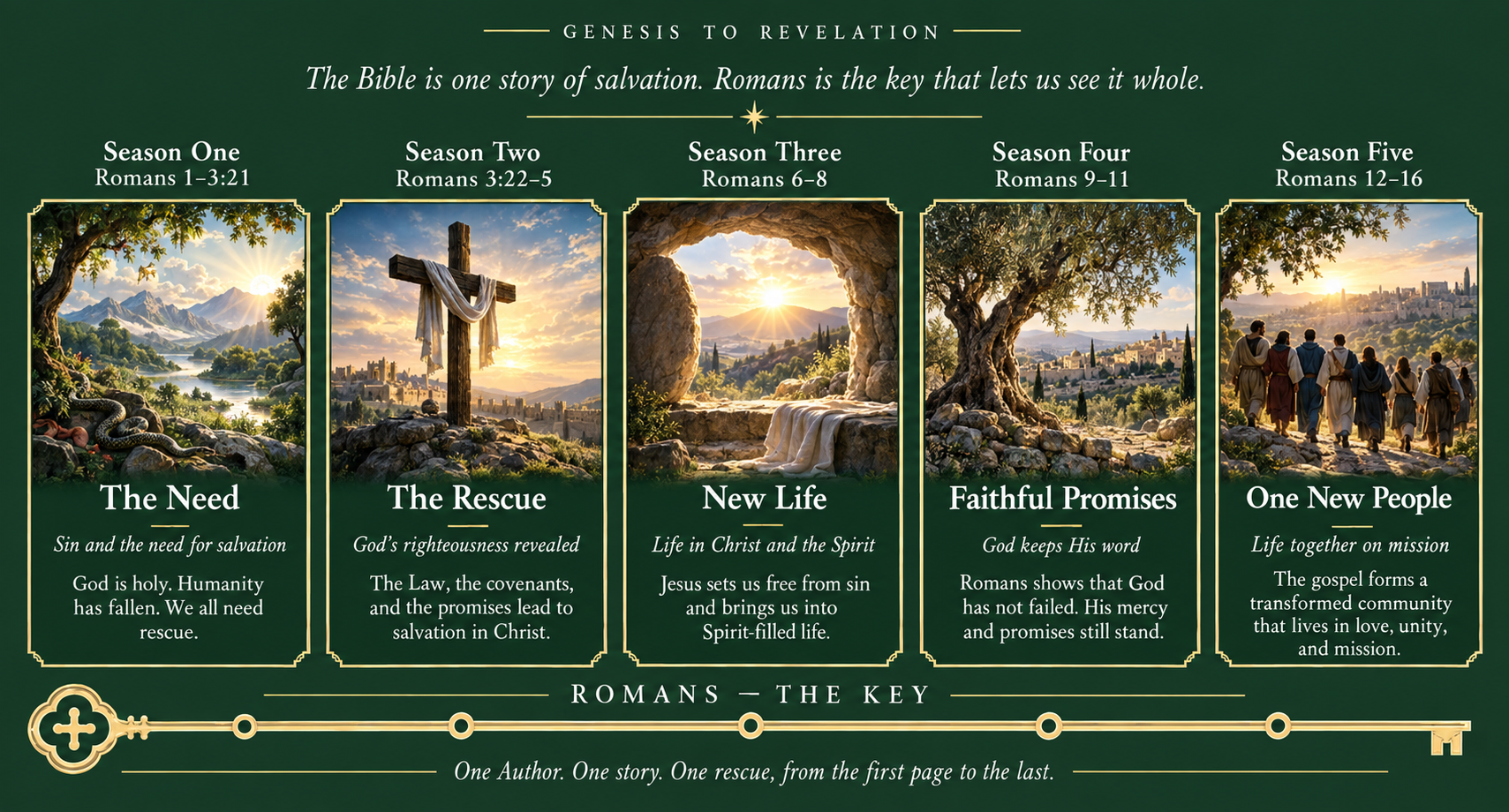
Welcome to the Second week of our new series entitled "The Mission." This is a journey through the book of Romans.
View entire series:
The Mission (Romans)
For more on the book of Romans, visit: * Bible Study: Romans. * My personal working commentary on Romans: Click Here. A Little About Romans: Romans has long been seen as the single greatest systematic theology of the Gospel. Many scholars believe the book of Romans can unlock the rest of the
 Brandon Cannon

For more on the book of Romans, visit:
- Bible Study: Romans.
- My personal working commentary on Romans: Click Here.
More on Controversial Issues Within The Text:
Is the Cross "Cosmic Child Abuse"? Why Substitutionary Atonement Is Good News
Question: Hey Pastor, if the Bible says that Jesus came to satisfy the just requirement of the Heavenly Father, doesn't that make the Cross something Cosmic Child Abuse? Answer: Ugh, no. But, great question. Let's talk about it. Every so often, a phrase comes along that sticks in
 Brandon Cannon
Declared Righteous: Is Justification Just a Legal Fiction?
Justification is part of the threefold work of Christ upon the Cross. See also: Bought Back: Who Got Paid When Jesus Redeemed Us?Some words in the Bible feel churchy. "Redemption" is one of them. We put it on coffee mugs and in song lyrics, and somewhere along the way
 Brandon Cannon
Bought Back: Who Got Paid When Jesus Redeemed Us?
Redemption is part of the threefold work of Christ upon the Cross. See also: Declared Righteous: Is Justification Just a Legal Fiction?Justification is part of the threefold work of Christ upon the Cross. See also: Bought Back: Who Got Paid When Jesus Redeemed Us?Some words in the Bible
 Brandon Cannon
Propitiation: Does God Need to Be Appeased?
Propitiation is part of the threefold work of Christ upon the Cross. See also: Declared Righteous: Is Justification Just a Legal Fiction?Justification is part of the threefold work of Christ upon the Cross. See also: Bought Back: Who Got Paid When Jesus Redeemed Us?Some words in the Bible
 Brandon Cannon
Today's Text:
(Romans 3:21-31) 21 But now God has shown us a way to be made right with him without keeping the requirements of the law, as was promised in the writings of Moses and the prophets long ago. 22 We are made right with God by placing our faith in Jesus Christ. And this is true for everyone who believes, no matter who we are.
23 For everyone has sinned; we all fall short of God’s glorious standard. 24 Yet God, in his grace, freely makes us right in his sight. He did this through Christ Jesus when he freed us from the penalty for our sins.25 For God presented Jesus as the sacrifice for sin. People are made right with God when they believe that Jesus sacrificed his life, shedding his blood. This sacrifice shows that God was being fair when he held back and did not punish those who sinned in times past, 26 for he was looking ahead and including them in what he would do in this present time. God did this to demonstrate his righteousness, for he himself is fair and just, and he makes sinners right in his sight when they believe in Jesus.
27 Can we boast, then, that we have done anything to be accepted by God? No, because our acquittal is not based on obeying the law. It is based on faith. 28 So we are made right with God through faith and not by obeying the law.
29 After all, is God the God of the Jews only? Isn’t he also the God of the Gentiles? Of course he is.30 There is only one God, and he makes people right with himself only by faith, whether they are Jews or Gentiles. 31 Well then, if we emphasize faith, does this mean that we can forget about the law? Of course not! In fact, only when we have faith do we truly fulfill the law.
Commentary.
Verses 21-23. God Offers Us A Way Out.
The beginning of this passage begins with "But Now God." This shows a distinct shift in the narrative. Paul has been spending the last couple of chapters talking about the state we are in. Now, Paul talks about what Christ has done about it.
Verse 21.
- But Now- Definite change in tone. It is not necessary to speak of temporal space. The passage is speaking of a pivot in the narrative.
- Made right- This refers to the debt of sin being satisfied.
- Without keeping the requirements of the law- Paul is saying this is the way to get to God without being perfect in the law, because He has established this is not possible.
- The law and the prophets- Many Jewish people called the law and the prophets the "righteousness of God" because the whole counsel of God revealed His full will to His people.
Verse 22.
- Right with God- This passage is a debate among Greek readers. One way to render this text is the way it is shown. Another way to render the text is to be made right "because of the faithfulness" of Christ. I tend to lean toward the second rendering. This places more of the power of salvation upon Christ and, therefore, works most closely with the surrounding text.
- Universality of salvation- Paul says that both Jews and Gentiles are all able to reach out for God.
- Definition of faith- Faith is not believing where there is no evidence. It is believing enough to place your trust in something. Faith = trust.
Verse 23.
- Definition of sin- Paul gives a great definition of sin as "falling short of God's glorious standard." This is an important distinction because it reminds us that we cannot reach God without His help.
Verses 24-27. The Way Out Is Through The Cross.
Verse 24.
- Makes us right in His sight- Other translations use the phrase "Justification." This is a legal term that means "just as if I" had never sinned. Because of what Christ has done, we are not simply pardoned from our sin. To be pardoned from our sin means we still have sin; we have just been forgiven of our transgressions. We still have to walk around realizing what we did and living with the secondary consequences of our sin. What Christ did completely expunged our sin so that it was as if it never happened in the eyes of God.
- He freed us from the penalty of sin- other translations use the word "Redemption." This is a commercial term that was often used in slave auctions. To redeem something was to buy it outright. To buy it completely. If it referred to a person, it meant you were not renting their services, but you were purchasing them for the rest of their natural life. It was a big deal. Depending on the person, it could be very expensive. Paul specifically uses this term because it is said that at some point, up to 70% of the people in the city of Rome may have been in some form of subjection. They understood this meant that Christ had purchased their ability to be free and then gave it to them.
Verse 25.
- God presented Jesus as the sacrifice for sin- The technical term for this is penal substitutionary atonement. This is the term used to describe how Jesus took our place. Some translations call it "Propitiation." This is the reminder that the Cross of Christ belonged to all of us who have sinned. He took our sin and shame and bought our freedom.
Verse 26.
- God was being fair in previous generations- This is a possibly thorny passage because it is hard to discern what is being said without the context. The previous passage has been speaking of how God has had a plan, but not all have been a part of the finalized portion. It seems to indicate that those who were before the Law was given were able to receive mercy due to ignorance because of the work of salvation on the Cross. This is not a blanket act of salvation for those who did not know Jesus. It is demonstrating that God has been completely just in all He has done. They were judged according to what they knew. Those during that time were judged completely justly according to what they knew. We are now not "let off the hook." Our sins still need to be forgiven. God is not able to just say don't worry about it because that would make Him unjust to all those who had come before. Therefore, God was unable to look past our sin and sent Jesus to make a way.
Verse 27.
- Paul reminds us that we are able to boast about anything. The reason why faith is so important is that faith points to God, not to our sufficiency.
Verses 28-31. The Way Leads Back To Fellowship With Him.
Verse 28.
- Our righteousness comes from the finished work of Jesus.
Verse 29.
- God is the same God to all. There is no division between Jews and Gentiles. This also speaks to the division between dispensationalists and those who promote covenant theology. Paul is saying there is no end to the grace extended to the Jewish people. It is just now extended fully to the Gentiles.
Verse 30.
- There is only One God. Paul is quoting from this Shema that declares that God is One.
Verse 31.
- Paul is fighting against anyone who would try to say he is promoting The Danger of Antinomianism or Sloppy Grace. He is saying that Jesus did not come so we would not have to fulfill the essence of the Law. Rather, it is through Jesus that we can do so.
Bottom line. The Gospel reveals the truth of our condition so we can realize the beauty of the Cross.
(Romans 1:16) For I am not ashamed of this Good News about Christ. It is the power of God at work, saving everyone who believes—the Jew first and also the Gentile.
Resources
Justified: A Survey of Romans 3:21-31 | From Daniel's Desk
From the Desk of Daniel J. Pentimone
 Daniel Pentimone

The Greatest Paragraph Ever Written | Romans 3:21-26 · H.B. Charles Jr.
In his Ars Poetica, the Roman poet Horace advised writers, “Do not bring a god onto the stage, unless the problem is one that deserves a god to solve it.” Romans follows this advice perfectly. Paul begins this letter with a God-sized problem: sin. Chapter 1 condemns Gentiles before God. Chapter 2 condemns the Jews before God. Romans 3:10-12 indicts us all: “None is righteous, no,…
 H.B. Charles Jr.
Romans 3 Commentary: Justified Freely by His Grace
Pastor David walks us through Romans 3 by first addressing the advantage of being Jewish—that God entrusted them with His written Word—and then handling…
 David Guzik

Faith in the Cross of Christ - Don Carson - Romans 3:21-31
Listen or read the following transcript as D. A. Carson speaks on the topic of faith in the cross of Christ from Romans 3:21-31.
 Don Carson