


This is the Final part of our series entitled: Built Different.
(Nehemiah 13) On that same day, as the Book of Moses was being read to the people, the passage was found that said no Ammonite or Moabite should ever be permitted to enter the assembly of God. 2 For they had not provided the Israelites with food and water in the wilderness. Instead, they hired Balaam to curse them, though our God turned the curse into a blessing. 3 When this passage of the Law was read, all those of foreign descent were immediately excluded from the assembly.
4 Before this had happened, Eliashib the priest, who had been appointed as supervisor of the storerooms of the Temple of our God and who was also a relative of Tobiah, 5 had converted a large storage room and placed it at Tobiah’s disposal. The room had previously been used for storing the grain offerings, the frankincense, various articles for the Temple, and the tithes of grain, new wine, and olive oil (which were prescribed for the Levites, the singers, and the gatekeepers), as well as the offerings for the priests.
6 I was not in Jerusalem at that time, for I had returned to King Artaxerxes of Babylon in the thirty-second year of his reign, though I later asked his permission to return. 7 When I arrived back in Jerusalem, I learned about Eliashib’s evil deed in providing Tobiah with a room in the courtyards of the Temple of God. 8 I became very upset and threw all of Tobiah’s belongings out of the room. 9 Then I demanded that the rooms be purified, and I brought back the articles for God’s Temple, the grain offerings, and the frankincense.
10 I also discovered that the Levites had not been given their prescribed portions of food, so they and the singers who were to conduct the worship services had all returned to work their fields. 11 I immediately confronted the leaders and demanded, “Why has the Temple of God been neglected?” Then I called all the Levites back again and restored them to their proper duties. 12 And once more all the people of Judah began bringing their tithes of grain, new wine, and olive oil to the Temple storerooms.
13 I assigned supervisors for the storerooms: Shelemiah the priest, Zadok the scribe, and Pedaiah, one of the Levites. And I appointed Hanan son of Zaccur and grandson of Mattaniah as their assistant. These men had an excellent reputation, and it was their job to make honest distributions to their fellow Levites.
14 Remember this good deed, O my God, and do not forget all that I have faithfully done for the Temple of my God and its services.
15 In those days I saw men of Judah treading out their winepresses on the Sabbath. They were also bringing in grain, loading it on donkeys, and bringing their wine, grapes, figs, and all sorts of produce to Jerusalem to sell on the Sabbath. So I rebuked them for selling their produce on that day. 16 Some men from Tyre, who lived in Jerusalem, were bringing in fish and all kinds of merchandise. They were selling it on the Sabbath to the people of Judah—and in Jerusalem at that!
17 So I confronted the nobles of Judah. “Why are you profaning the Sabbath in this evil way?” I asked. 18 “Wasn’t it just this sort of thing that your ancestors did that caused our God to bring all this trouble upon us and our city? Now you are bringing even more wrath upon Israel by permitting the Sabbath to be desecrated in this way!”
19 Then I commanded that the gates of Jerusalem should be shut as darkness fell every Friday evening, not to be opened until the Sabbath ended. I sent some of my own servants to guard the gates so that no merchandise could be brought in on the Sabbath day. 20 The merchants and tradesmen with a variety of wares camped outside Jerusalem once or twice. 21 But I spoke sharply to them and said, “What are you doing out here, camping around the wall? If you do this again, I will arrest you!” And that was the last time they came on the Sabbath. 22 Then I commanded the Levites to purify themselves and to guard the gates in order to preserve the holiness of the Sabbath.
Remember this good deed also, O my God! Have compassion on me according to your great and unfailing love.
23 About the same time I realized that some of the men of Judah had married women from Ashdod, Ammon, and Moab. 24 Furthermore, half their children spoke the language of Ashdod or of some other people and could not speak the language of Judah at all. 25 So I confronted them and called down curses on them. I beat some of them and pulled out their hair. I made them swear in the name of God that they would not let their children intermarry with the pagan people of the land.
26 “Wasn’t this exactly what led King Solomon of Israel into sin?” I demanded. “There was no king from any nation who could compare to him, and God loved him and made him king over all Israel. But even he was led into sin by his foreign wives. 27 How could you even think of committing this sinful deed and acting unfaithfully toward God by marrying foreign women?”
28 One of the sons of Joiada son of Eliashib the high priest had married a daughter of Sanballat the Horonite, so I banished him from my presence.
29 Remember them, O my God, for they have defiled the priesthood and the solemn vows of the priests and Levites.
30 So I purged out everything foreign and assigned tasks to the priests and Levites, making certain that each knew his work. 31 I also made sure that the supply of wood for the altar and the first portions of the harvest were brought at the proper times.
Remember this in my favor, O my God.
The Book of Nehemiah in One Sentence:
- The Book of Nehemiah is about a man who rebuilt a city by rebuilding a people.
Interesting Facts:
- The book of Malachi was likely written between chapters 12 and 13 of the book of Nehemiah.
- The final verses in Nehemiah were likely the last words written in the Old Testament.
Final Part: We Make It Better Together.
The Chapter Three Overview.
Nehemiah had left, and time had passed. While we do not know exactly how much time, it could have been as little as one year. He went back to the king in Susa. It seems that as soon as he left, the people began to drift from their commitments to God. Nehemiah returns to restore order.
Verse 1-14: Nehemiah Restores Giving.
- Verse 1-3: Many scholars connect these verses to the previous chapter. The main segway happens in verse four, where we see the people beginning to go back to their old ways.
- Verse 1-3: This is not a sign of racism because the issue was not their ethnicity. It was their unwillingness to help the people of God in their time of need.
- Verse 4: It is disputed whether or not the priest "Eliashib" is the same one who is stated elsewhere to be the high priest. One reason is that this name means "God Who Brings Back." This was apparently a common nickname given to many priests at the time. Also, it is unlikely the high priest would have been in charge of the storage facilities.
- Verse 4-5: For some reason, they had moved out the tithes and offerings to make space for the enemy of God, Tobiah.
- Verse 6: Nehemiah had gone back to the King. He served as governor for 12 years. Some Jewish commentaries say his brother Haniah became governor in his place. It is unknown how long he was in Susa before returning. Because the trip from Jerusalem to Susa took roughly 60 days, he could have been gone as little as six months. However, the amount of time is not as big a deal as the fact that the people began to slide back into their old ways with Nehemiah gone.
- Verse 10: It was commanded by God that the tithe of the people would support the priests and levites so they could do the work of the Lord. Since they were not getting provided for, they had to leave the work of the Lord to support their families.
- Verse 11: Nehemiah reminds them that they didn't sin against the Levites. They are sinning against the Lord.
- Verse 13: Nehemiah assigned trustworthy men to keep up with the offerings.
- Verse 14: This is the first of four prayers by Nehemiah in this chapter. Three are asking for God's remembrance, and the other is asking God to judge his enemies.
Verse 15-22: Nehemiah Restores Time With God.
- Verse 15: The second issue Nehemiah had to fix was the brokenness in honoring God with their time and worship.
- Verse 15: Sabbath was to be taken every seven days. It was a time to rest and worship the Lord. The idea was also that it was a gift and a discipline. You trusted that God would help you in six days to get down what could have been done in seven so you can rest on the seventh. They were no longer worshiping God with their time.
- Verse 17: Nehemiah reminds them that they are sinning against God by doing this.
- Verse 19-22: Nehemiah helped them "pre-decide" to honor God by removing temptation. The gate would be closed so they would not be tempted to sin against the Lord.
Verse 23-31: Nehemiah Restores Holiness.
- Verse 23: The final issue to fix was the people's desire to disobey God's law to not intermarry. Once again, this was not due to any form of racism. We can see in the text that the problem was that the children were losing their connection with God due to their loss of the language in which God's Law was written. It was also important because the book of Deuteronomy talked about how intermarrying would also bring in idol worship.
- Verse 26: Nehemiah reminds them that it is God they are sinning against and bringing destruction on themselves.
- Verse 28: He was likely banished to go live with his father-in-law.
- Verse 29: Nehemiah prays for judgment.
- Verse 30: Nehemiah's talent for administration shines. He organizes the people again.
- Verse 31: The book of Nehemiah ends as it began, with prayer. It also ends unceremoniously. It is possible some would expect a grand ending to the Old Testament. However, the story was not through. Four hundred years later, the king would come.
(1 Corinthians 4:20) For the Kingdom of God is not justa lot of talk; it is LIVING BY GOD’S POWER.
Resources to Nehemiah
Nehemiah
Like a good detective, let’s examine this book. 🔥 Overview The book of Nehemiah can easily be seen as a sequel to the book of Ezra. While Ezra is focused on restoring the worship to the nation of Israel, Nehemiah is not a priest. He is a man from the
 Brandon Cannon
Journey Through Nehemiah - Enjoying the Journey
God used Nehemiah’s leadership to rebuild the ruined walls of Jerusalem. In just 52 days, they were completely restored. Begin Your Journey Through Nehemiah:
 Scott Pauley
Rebuild: A Study in Nehemiah
Join Kathleen Nielson and D. A. Carson on an 8-session journey through the final act of the Old Testament, the book of Nehemiah.


Nehemiah 13 Commentary: Nehemiah’s Reforms
Pastor David walks us through Nehemiah’s return to Jerusalem after years away, where he discovers that the spiritual gains won in the earlier revival have…
 David Guzik
Nehemiah 13 Summary - 5 Minute Bible Study — 2BeLikeChrist
Nehemiah 13 is the final chapter of the book. It documents Nehemiah’s short return to Persia and his reforms in Judah. These reforms included separating the people from the foreign nations, evicting Tobiah from the Temple grounds, reestablishing respect for the Sabbath Day, and restoring provisions
 Luke Taylor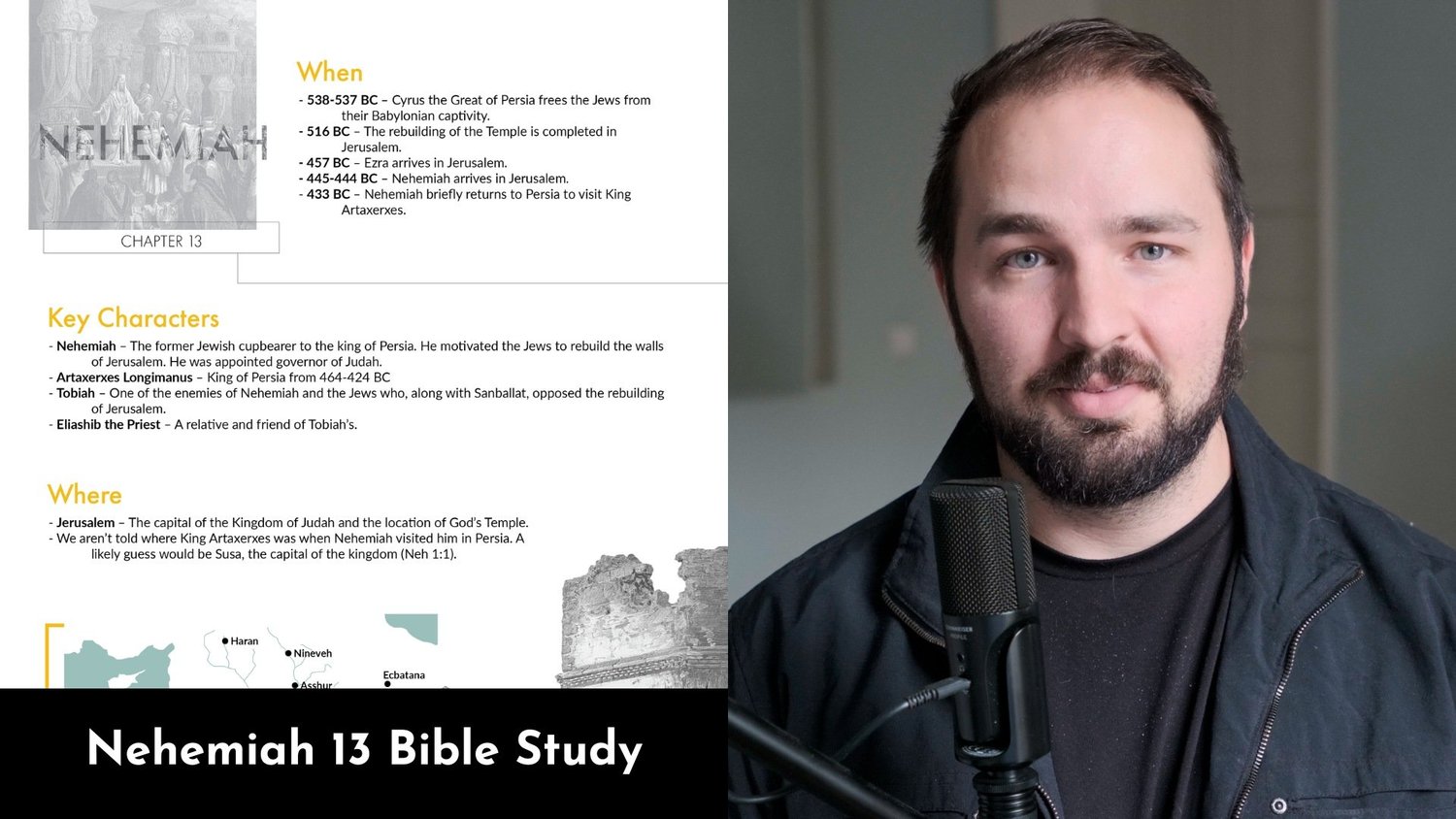
Nehemiah 13 - Fighting the Currents of Complacency Pt. 2
We have powerful experiences with God, only to find that over time, the power of that encounter begins to fade in our memory
 Grace Community Church
Nehemiah 13:4-31 – Study Scripture Online


Nehemiah 13 Bible Commentary - Matthew Henry (concise) | Christianity.com
Study Nehemiah 13 using Matthew Henry’s Bible Commentary (concise) to better understand Scripture with full outline and verse meaning.